
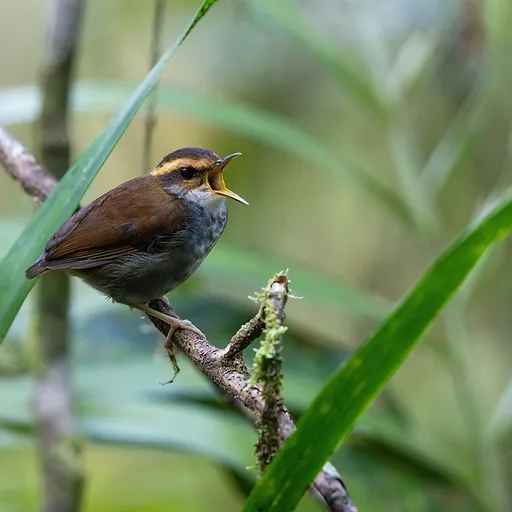
Bornean Stubtail
Urosphena whiteheadi
Least Concern
Overview
The Bornean stubtail (Urosphena whiteheadi) is a small, short-tailed warbler endemic to the island of Borneo. It belongs to the cettiid warbler family and is currently classified as Least Concern due to its sufficiently large range and stable population.
Identification
- A very small warbler measuring 9.5–10 cm in length with long legs and a very short tail.
- Brown upperparts and greyish-white underparts that turn grey at the sides of the breast and flanks, with a light yellow-brown belly.
- Long, buffish-brown supercilia contrasting with an equally long dark grey eyestripe, thin yellow eye-ring, and orange-buff cheeks.
- Pale pink legs and a dark brownish-black bill; both sexes are similar in appearance.
Habitat
This species inhabits the forest floor and undergrowth of montane forests at elevations ranging from 750 to 3,150 m. Its range covers the mountain ranges of Borneo, extending from Mount Kinabalu south to Liang Kubung, the Müller Mountains, Mount Dulit, and Gunung Menyapa, as well as the southeastern Meratus Mountains.
Diet
The Bornean stubtail feeds primarily on invertebrates, especially green aphids. It forages on the ground and in dense undergrowth, creeping about in an inconspicuous, mouse-like manner.
Did you know?
The incubation period for its eggs averages 24 days, which is unusually long for the species' region. This extended duration is caused by parents spending six to eight hours each day away from the nest.
Sources
- Wikipedia · CC BY-SA 4.0
- Wikidata · CC0 1.0