
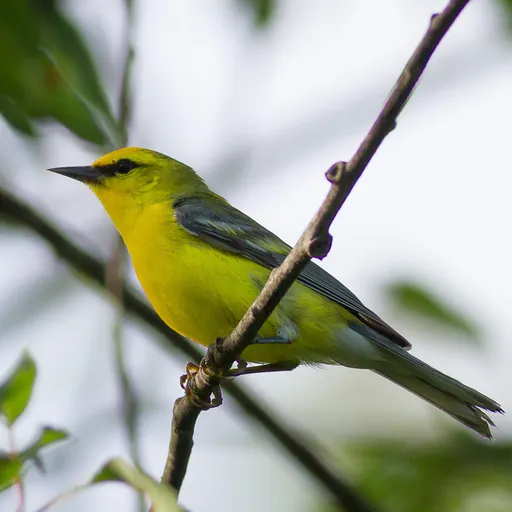
Blue-winged Warbler
Vermivora cyanoptera
Least Concern
Overview
The blue-winged warbler (Vermivora cyanoptera) is a fairly common migratory New World warbler that breeds in eastern North America and winters in southern Central America. Its breeding range is currently extending northwards, where it is gradually replacing the closely related golden-winged warbler.
Identification
- Males display a bright yellow head and underparts, contrasted with bluish-gray wings featuring two distinct white wing-bars and a narrow black eye-line.
- Females are duller with less yellow on the crown and a less prominent, greyish eye-line.
- Juveniles appear olive green with a pinkish bill and barely visible wing bars.
- The song consists of a series of buzzing notes, accompanied by a sharp chip call.
Habitat
Breeding habitat consists of open, scrubby areas such as abandoned fields with shrubs and trees, typically bordered by tall deciduous trees. The species generally occupies higher elevations with a high percentage of grass and canopy cover. Its breeding range extends from east-central Nebraska and southern Minnesota eastwards to New England, and southwards to western South Carolina and northern Alabama.
Diet
The diet consists primarily of insects and spiders, which are gleaned from various plants including apple trees, walnut trees, and water hemlock. Adults sometimes hang upside down to probe leaves for insect larvae to feed their young. As a generalist species, its feeding methods may vary by season and habitat due to resource availability.
Did you know?
The blue-winged warbler and the golden-winged warbler are genetically 99.97% alike, having diverged approximately 1.5 million years ago. Where their ranges overlap, they can hybridise freely to produce two distinct hybrid types: the genetically dominant Brewster's warbler and the rarer Lawrence's warbler.
Sources
- Wikipedia · CC BY-SA 4.0
- Wikidata · CC0 1.0