
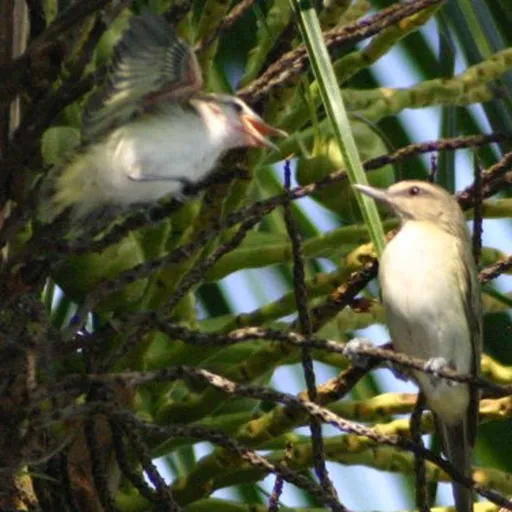
Black-whiskered Vireo
Vireo altiloquus
Least Concern
Listen
XC792558 · Rosa Elena Albornoz · Mariño (near Porlamar), Mariño Municipality, Nueva Esparta, Nueva Esparta, Venezuela · CC0 1.0
Overview
The black-whiskered vireo (Vireo altiloquus) is a small passerine bird belonging to the family Vireonidae. It is a widespread species found across the Caribbean, southern Florida, and parts of northern and Amazonian South America, currently assessed as Least Concern on the IUCN Red List.
Identification
- 15 to 16.5 cm long with a stout black bill, black legs and feet, and a reddish brown iris.
- Bluish gray forehead and crown with a buff-olive tinge, olive-green upperparts, and whitish underparts with a slight buff or greenish-olive tinge.
- Distinctive wide dusky eye-stripe and the eponymous black 'whisker' on the sides of the throat.
- Song consists of short, melodious 2- to 3-syllable phrases described as 'whip-Tom-Kelly' or 'sweet-John', sung by males from the canopy.
Habitat
The species inhabits a wide variety of landscapes, ranging from coastal mangroves and subtropical hardwood hammocks in Florida to all forest types at all elevations in the Caribbean. In South America, it favours the edges and clearings of moist to humid evergreen forests in the Amazon Basin and northern regions. Its distribution includes southern Florida, the Bahamas, the Greater and Lesser Antilles, Trinidad and Tobago, and mainland countries including Brazil, Colombia, Guyana, Suriname, and Venezuela.
Diet
The black-whiskered vireo feeds on fruit and arthropods in approximately equal amounts, with the ratio varying by season and location. It forages primarily by gleaning from foliage while perched or after a short sally, though it also glean from bark and twigs and rarely takes insects in mid-air.
Did you know?
The species is subject to brood parasitism by the shiny cowbird throughout its range, with a few additional records of brown-headed cowbird parasitism in Florida. In one study in Puerto Rico, approximately 70% of nests were destroyed by predators, though the identity of these predators remains unknown.
Sources
- Wikipedia · CC BY-SA 4.0
- Wikidata · CC0 1.0