
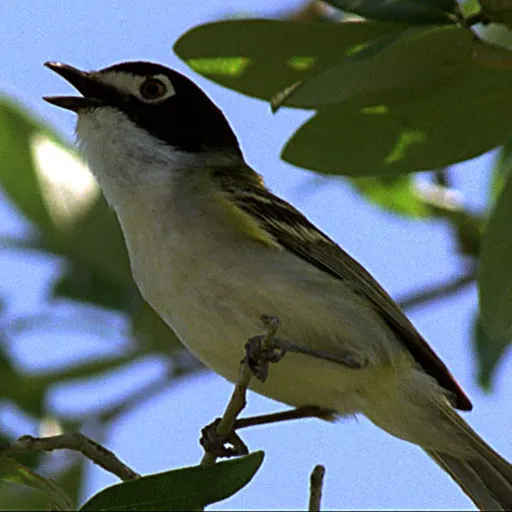
Black-capped Vireo
Vireo atricapilla
Near Threatened
Overview
The black-capped vireo (Vireo atricapilla) is a small songbird native to the United States and Mexico. It is distinguished as the only sexually dichromatic species within the Vireo genus and currently holds a Near Threatened status on the IUCN Red List.
Identification
- A small bird approximately 12 cm in length with a black crown and upper head in mature males, and slate-gray in females and first-year males.
- Males display olive-green upperparts, white underparts, and faint yellow flanks, while females have duller colours with greenish-yellow washes.
- Features a black bill and brownish-red irises, with a partial white eye ring and lores in males.
Habitat
This species inhabits 'shinneries', which are brushy areas with scattered trees primarily consisting of shin oak or sumac. Foliage extending to ground level is a critical requirement, with preferred habitat on level terrain averaging 2.5 to 3.5 m in height. Its current range extends from Oklahoma through the Edwards Plateau and Big Bend National Park in Texas to central and southwestern Mexico, including parts of Coahuila and Tamaulipas.
Diet
Black-capped vireos are insectivorous, with beetles and caterpillars constituting a significant portion of their diet. During the nestling phase, the male typically supplies most of the food while the female broods over the young.
Did you know?
The species is the only Vireo that is sexually dichromatic. Breeding pairs are capable of producing more than one clutch per season, allowing the female to nest again while the male cares for the fledglings from the first brood.
Sources
- Wikipedia · CC BY-SA 4.0
- Wikidata · CC0 1.0