
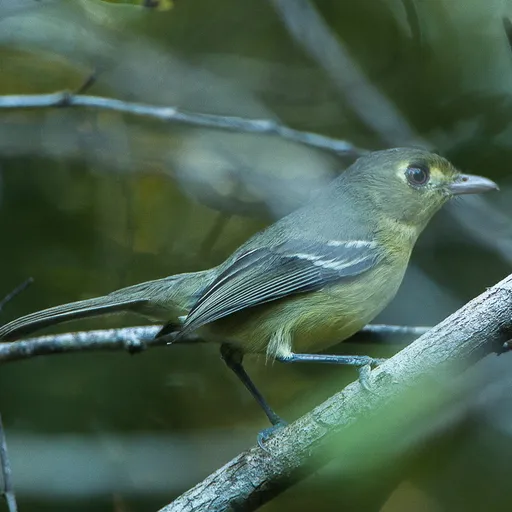
Cuban Vireo
Vireo gundlachii
Least Concern
Overview
The Cuban vireo (Vireo gundlachii) is a small passerine bird endemic to Cuba. It belongs to the family Vireonidae and is currently classified as Least Concern by the IUCN.
Identification
- Approximately 13 cm in length with a weight between 11 and 15 g.
- Plumage: Olive-gray upperparts and crown, with yellowish or creamy-white lores and ear coverts; two faint wing bars formed by pale tips on brownish-gray wing coverts; yellowish underparts.
- Bill and Legs: Gray-brown upper mandible, paler lower mandible, and lead-gray legs.
- Song: A high, oft-repeated 'wi-chiví, wi-chiví' phrase, accompanied by rapid descending 'chi' notes and other calls.
Habitat
The Cuban vireo inhabits the edges of evergreen and deciduous forests, as well as brushlands, thickets, and scrublands from sea level up to around 700 m, though it can occur at higher elevations. It is distributed across Cuba, including Isla de la Juventud, with different subspecies occupying specific regions such as the Cayos de San Felipe and Cayo Cantiles.
Diet
The bird feeds on insects, fruits, and small lizards. It forages primarily in pairs and frequently joins mixed-species feeding flocks, typically operating in low vegetation.
Did you know?
The species was formerly known by several local names, including 'Petit-bobo' and 'Juanchiví', before receiving its scientific binomial in 1850 to honour the Cuban zoologist Juan Gundlach.
Sources
- Wikipedia · CC BY-SA 4.0
- Wikidata · CC0 1.0