
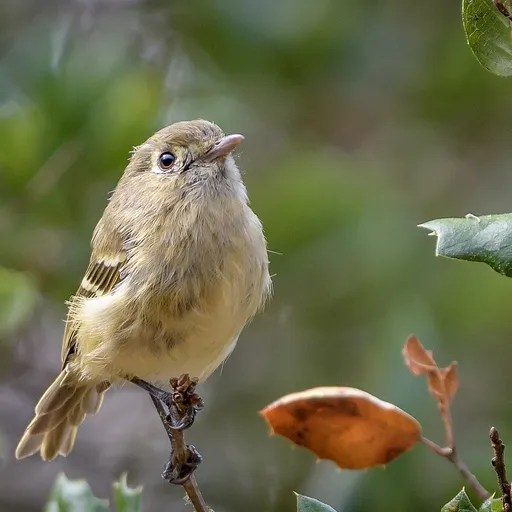
Hutton's Vireo
Vireo huttoni
Least Concern
Overview
Hutton's vireo is a small songbird in the family Vireonidae found from southwestern Canada to Guatemala. The species is assessed as Least Concern by the IUCN, with an extremely large range and an estimated population of at least 2.7 million mature individuals that is believed to be increasing.
Identification
- Length of 10 to 12 cm and weight of 9 to 15 g, with sexes sharing the same plumage.
- Plumage varies by subspecies but generally features olive upperparts that become greener on the rump, yellowish white underparts with a pale buff to grayish olive wash, and two pale yellowish olive wing bars.
- Distinctive facial features include pale lores, a wide broken pale whitish eye-ring, a dark brown iris, and a blackish to pale brown maxilla with a paler mandible.
- Legs and feet are blue-gray to dark gray.
Habitat
Found in a variety of subtropical and temperate landscapes, including evergreen conifer and live oak forests in the Pacific region, and pine, pine-oak, and pine-oak-juniper woodlands in inland areas. Elevation ranges from sea level to about 250 m in British Columbia, up to 1,800 m in the Pacific North American states, and between 1,200 and 3,500 m in Mexico and Guatemala.
Diet
The species feeds primarily on insects, supplemented by spiders and small fruits. It forages methodically by gleaning prey from leaves, flowers, twigs, and bark, sometimes hanging upside-down or briefly hovering, and also captures insects in mid-air.
Did you know?
During the breeding season, the bird constructs its cup-shaped nest using a wide variety of materials including plant fibers, plant down, lichens, mosses, grasses, and feathers, all held together with spider web. In some areas, up to half of the nests are parasitised by brown-headed or bronzed cowbirds.
Sources
- Wikipedia · CC BY-SA 4.0
- Wikidata · CC0 1.0