
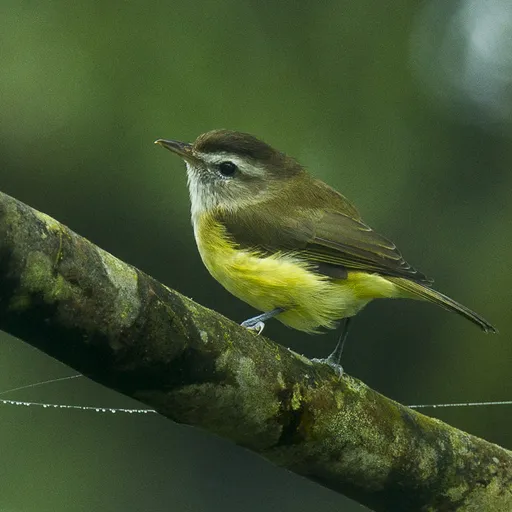
Brown-capped Vireo
Vireo leucophrys
Least Concern
Listen
XC1093620 · Rosa Elena Albornoz @rosaelena_naturaleza · San Antonio De Los Altos, Los Salias, Miranda, Venezuela · CC0 1.0
Overview
The brown-capped vireo (Vireo leucophrys) is a small passerine bird classified within the family Vireonidae. It is a year-round resident found across a wide range in the Americas, from Mexico through Central America to South America. The species is assessed as Least Concern on the IUCN Red List despite a decreasing population trend.
Identification
- Length of 11.5 to 12.5 cm with a weight of approximately 12 to 13.5 g, featuring sexes with identical plumage.
- Olive-brown to grayish brown crown, a white supercilium, and a dusky streak behind the eye, with grayish white ear coverts.
- Upperparts are grayish olive to brownish olive-green, while the throat and upper breast are grayish white and the rest of the underparts are pale yellow.
- Bill has a dark brown, gray, or black maxilla and a horn or whitish mandible with a blue-gray streak; legs and feet are blue-gray or bluish gray.
- Song is a short, sweet, 2.5 to 3-second warble that is silky and somewhat hurried, with a call described as a wheezing, descending 'zreeEEEEw'.
Habitat
The brown-capped vireo inhabits forested landscapes in subtropical and temperate zones, including humid montane forest, mature secondary forest, and coffee plantations. In northern Central America, it occurs in cloudforest and pine-oak or oak forest. It ranges in elevation from 500 m to 2,700 m across its distribution in Mexico, Central America, and South America.
Diet
The bird feeds primarily on insects, with smaller amounts of berries included in its diet, though specific details are lacking. It forages singly or in pairs, usually as part of a mixed-species feeding flock. Prey is typically taken in the upper levels of the forest or on isolated trees, where the bird is often seen hanging upside-down to glean or probe.
Did you know?
The brown-capped vireo often hangs upside-down to glean or probe for prey in the upper levels of the forest. Its nests are cups made from plant fibers and moss suspended in branch forks, situated approximately 8 m above the ground.
Sources
- Wikipedia · CC BY-SA 4.0
- Wikidata · CC0 1.0