
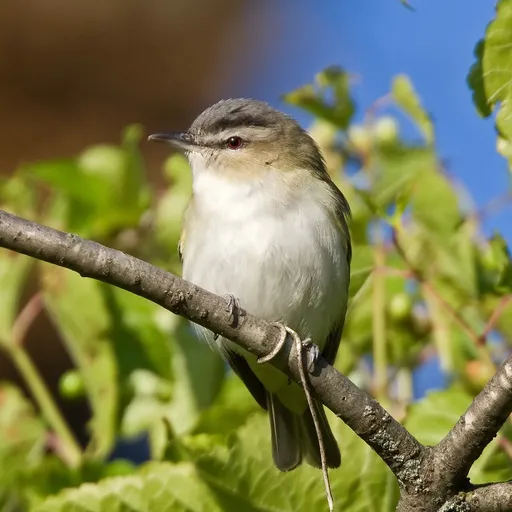
Red-eyed Vireo
Vireo olivaceus
Least Concern
Listen
XC757630 · Quinn Desilets · Seba Beach, Parkland County, Alberta, Canada · CC0 1.0
Overview
The red-eyed vireo (Vireo olivaceus) is a small American songbird that is common across its vast range and currently classified as Least Concern. Although it appears somewhat warbler-like, it is not closely related to the New World warblers.
Identification
- Olive-green upper parts with white underparts and yellowish flanks.
- Distinctive red iris, grey crown edged with black, and a dark line through the eyes bordered by a wide white stripe.
- Stout bill and thick blue-grey legs.
- Prolific singer that uses a question-and-answer rhythm to produce over 20,000 songs in a single day.
Habitat
This species breeds in open wooded areas across Canada and the eastern and northwestern United States, migrating to South America for the winter. It is an exclusively migratory species that utilises Latin America and Mexico as stopovers, with rare vagrant records in Europe and western North America.
Diet
In their summer range, they are primarily insectivorous, gleaning caterpillars, beetles, and aphids from tree foliage to build fat reserves. During the winter, they are almost exclusively frugivores, often hanging upside down to reach berries from fruiting trees such as the tamanqueiro and gumbo-limbo.
Did you know?
The red-eyed vireo holds the record for the most songs given in a single day among bird species, with individuals capable of producing more than 20,000 songs. They are also one of the most frequent American passerine vagrants in Europe, with over a hundred records, mainly in Ireland and Great Britain.
Sources
- Wikipedia · CC BY-SA 4.0
- Wikidata · CC0 1.0