
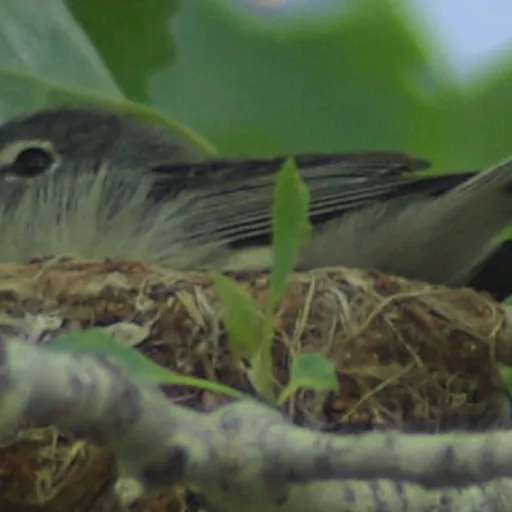
Plumbeous Vireo
Vireo plumbeus
Least Concern
Listen
XC717733 · Diana Doyle · Grass Shack Campground, Saguaro Nat'l Park, Rincon Mtns, Arizona, United States · CC BY-SA 4.0
Overview
The plumbeous vireo (Vireo plumbeus) is a small North American songbird belonging to the family Vireonidae. It possesses a disjunct distribution, ranging from the western United States and Mexico through to Central America. The species is currently classified as Least Concern on the IUCN Red List, although its population is believed to be decreasing.
Identification
- Adults feature a neutral gray crown and nape, a wide white stripe above the lores, and a wide white eye-ring with a dusky stripe through it.
- Upperparts are neutral gray with an olive-green tinge on the rump, while wing coverts display blackish gray with whitish tips forming two wing bars.
- Underparts are mostly nearly white, often with smudgy pale grayish olive on the breast sides and occasional very pale sulfur yellow on the flanks.
- Males sing a jerky series of burry phrases, such as "ch'reeh ch'roo ch'reeh ch'roo", alternating between ascending and descending notes.
Habitat
The species inhabits a variety of landscapes, primarily coniferous and mixed pine-oak forests in the United States, and pine-oak and oak scrublands in Mexico. During migration and overwintering, it utilises a broader range of habitats, including gallery forest, mangroves, and plantations. Breeding populations occupy elevations between 1,150 and 2,500 m in the central United States, while Mexican populations range from sea level to 3,000 m.
Diet
During the breeding season, the plumbeous vireo feeds almost entirely on arthropods, gleaning food from leaves and branches or capturing it in mid-air. In winter, it adds fruits to its diet and frequently joins mixed-species feeding flocks.
Did you know?
The nest, built from grass, bark strips, plant fibers, and animal hair, is often decorated on the exterior with lichens, moss, and human-made materials such as string.
Sources
- Wikipedia · CC BY-SA 4.0
- Wikidata · CC0 1.0