
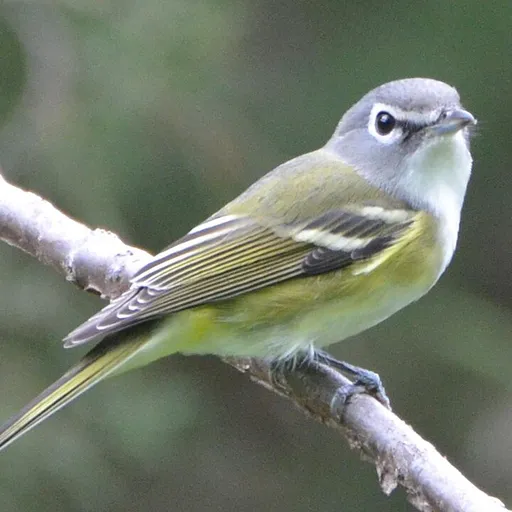
Blue-headed Vireo
Vireo solitarius
Least Concern
Listen
XC1089336 · steve · Salem, Burke County, North Carolina, United States · CC BY-SA 4.0
Overview
The blue-headed vireo (Vireo solitarius) is a migratory songbird native to North and Central America. Classified as a species of Least Concern by the IUCN, its populations have been steadily increasing since the 1970s.
Identification
- A small passerine measuring 126–148 mm in length with a wingspan of 200–240 mm.
- Distinguishing features include a deep blue-grey crown, olive green upper body, and two bold yellow wing bars.
- Males and females exhibit very little sexual dimorphism, appearing similar in both plumage and size.
- The primary song, sung by males during the breeding season, is a simple, slow, and monotonous tune that is frequently confused with the faster song of the red-eyed vireo.
Habitat
Breeding occurs in cool temperate forests featuring a mix of evergreen conifers such as spruce, fir, and hemlock, alongside deciduous undergrowth like alder, willow, and birch. In the southern portions of its range, these habitats are typically found at higher elevations. During the non-breeding season, the species inhabits mixed woods of pines and hardwoods, as well as coastal and floodplain swamps.
Diet
Primarily insectivorous, the blue-headed vireo forages in the mid-levels of trees by hopping between branches and flying short distances to capture prey. Its diet includes caterpillars, beetles, flies, spiders, and occasionally snails, though it also consumes fleshy berries and fruit, particularly during migration and overwintering in tropical regions.
Did you know?
Unlike most bird species, female blue-headed vireos do not engage in extra-pair copulations, while males remain highly involved in nest building, daytime incubation, and feeding the chicks, making the species both socially and genetically monogamous.
Sources
- Wikipedia · CC BY-SA 4.0
- Wikidata · CC0 1.0