
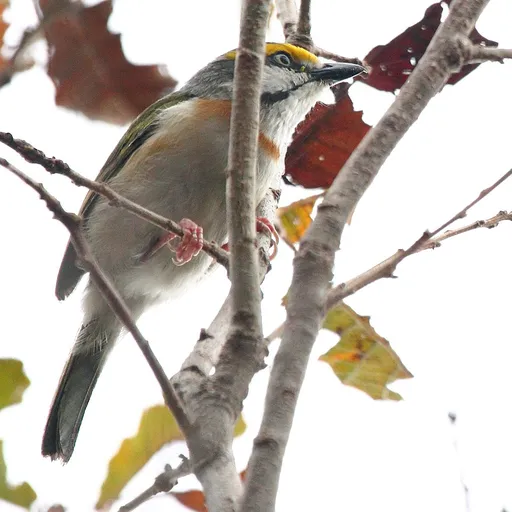
Chestnut-sided Shrike-Vireo
Vireolanius melitophrys
Least Concern
Overview
The chestnut-sided shrike-vireo, also known as the honey-browed shrike-vireo, is a bird in the family Vireonidae and is likely the largest member of this entire family. This widespread species inhabits subtropical and tropical moist montane forests, ranging from Mexico to Guatemala. It is currently classified as a species of Least Concern by the IUCN Red List.
Identification
- Length ranges from 16.5 to 18 cm with a mean body mass of 34.7 g, making it one of the largest vireos alongside the Cozumel rufous-browed peppershrike.
- Features bright green backs, largely white undersides, and distinctive chestnut flanks that meet in a chest band, with females exhibiting paler plumage and reduced chestnut coloration compared to males.
- Head is marked by a slate crown and nape, golden-yellow eyebrows reaching the lores, thin black eyelines thickest near the gray nape, white cheeks, thin black malars, and a white throat.
- Possesses pink legs and yellow irides, with a complex, multi-pitched single-syllable whistle that ascends in pitch with multiple harmonics before descending, audible up to 400 metres away.
Habitat
This humid pine-oak specialist is restricted to montane habitats from Jalisco and San Luis Potosi in central Mexico to southern Guatemala. It is typically found in tropical and subtropical forest zones mostly above 1,800 metres, though some populations occur as low as 1,200 metres in certain regions. The species is nowhere common, possessing one of the lowest relative abundances of any medium-sized songbird in Oaxacan pine-oak forests.
Diet
Forages for arthropods such as caterpillars, wasps, grasshoppers, bugs, spiders, and beetles primarily in the leaves and epiphytic vegetation within the inner foliage of trees. Large arthropods over 70 mm are beaten to death in branches or held in the feet to be dissected with the bill. Birds occasionally consume vegetation and engage in frugivory, foraging alone or in pairs with methodical movements between perches approximately one metre apart.
Did you know?
Males often engage in physical combat during territorial disputes, latching onto one another while calling and beating each other with their wings. When agitated, these birds will raise their crown feathers and occasionally fan their tails, though they maintain relatively large territories of up to 4 hectares or more.
Sources
- Wikipedia · CC BY-SA 4.0
- Wikidata · CC0 1.0