
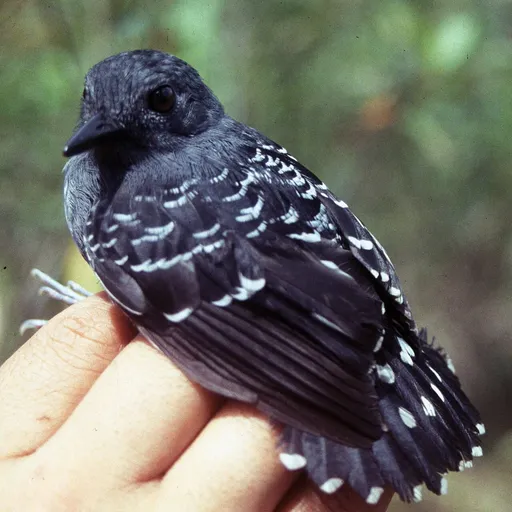
Common Scale-backed Antbird
Willisornis poecilinotus
Least Concern
Listen
XC249929 · Niels Krabbe · Morona-Santiago: e-slope Cord. de Cutucú: Uuntsuants, Ecuador · CC BY-SA 4.0
Overview
The common scale-backed antbird (Willisornis poecilinotus) is a passerine bird belonging to the subfamily Thamnophilinae of the typical antbirds. It is a year-round resident found across a vast range in South America, including Bolivia, Brazil, and Venezuela, and is currently classified as Least Concern by the IUCN.
Identification
- Length of 12 to 13 cm and weight between 15 to 22 g.
- Adult males are mostly grey with darker upperparts, a white patch between the scapulars, and white-edged black patches on the lower back; females have a reddish yellow-brown crown and face with olive-brown upperparts.
- Wings and tail are black or dark olive-brown with white edges and tips; females of certain subspecies exhibit cinnamon-rufous belly centers or black lower backs with wide white feather edges.
- Song consists of a series of long upslurred notes that rise in pitch and intensity, described as "pureeeee" in Venezuela and "teeuw, tuweeé?" in Ecuador, accompanied by calls such as a sharp "psit" or a descending "chirr".
Habitat
Primarily inhabits the understorey of humid terra firme evergreen forest, as well as várzea and igapó forests. The species reaches elevations of up to 1,350 m in Brazil and Venezuela, though it is mostly found below 900 m in Peru and 700 m in Ecuador.
Diet
Feeds mostly on a wide variety of arthropods and occasionally small lizards. It forages individually, in pairs, or in family groups usually within 1 m of the ground, capturing prey by short sallies from perches to the ground or foliage, and sometimes by probing and flicking leaf litter. While it joins mixed-species flocks and follows army ant swarms, it forages independently as often as it accompanies swarms.
Did you know?
The bird's English name derives from the Ancient Greek specific epithet poikilonōtos, meaning "with variegated back," which describes the white-edged black patches on the lower back that give the species its distinctive appearance. The female is believed to incubate the eggs alone at night, while both parents participate in incubation during the day and in brooding and provisioning the nestlings.
Sources
- Wikipedia · CC BY-SA 4.0
- Wikidata · CC0 1.0