
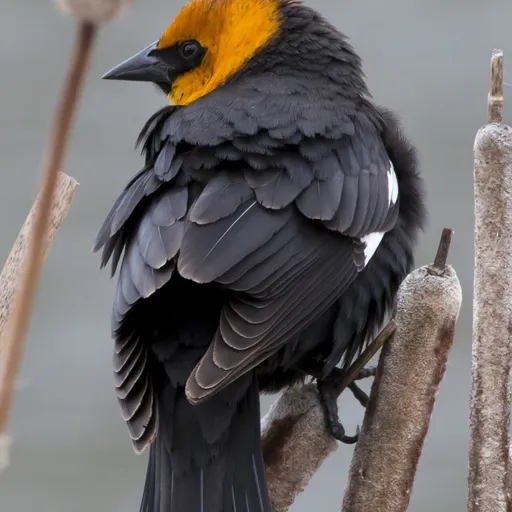
Yellow-headed Blackbird
Xanthocephalus xanthocephalus
Least Concern
Overview
The yellow-headed blackbird (Xanthocephalus xanthocephalus) is a medium-sized blackbird characterised by its yellow head. It is the sole member of the genus Xanthocephalus and is currently classified as Least Concern on the IUCN Red List.
Identification
- Adults measure 8.3–10.2 in (21–26 cm) in length with a wingspan of 16.5–17.3 in (42–44 cm) and weigh 1.6–3.5 oz (44–100 g).
- Adult males are mainly black with a yellow head and breast, featuring a white wing patch sometimes visible only in flight.
- Adult females are mainly brown with a dull yellow throat and breast, while immature birds of both sexes are brown with duller yellow plumage.
- Males possess a pointed bill and produce two types of songs: a lower-pitched 'accent song' and a higher-pitched 'buzz song' that resembles the grating of a rusty hinge.
Habitat
These birds inhabit marshes in North America, primarily west of the Great Lakes, utilising vegetation such as cattails, bulrush, and common reeds for nesting. While permanent residents of the San Joaquin Valley and the Lower Colorado River Valley in the United States, most populations migrate in large flocks to the southwestern United States and Mexico during the winter.
Diet
For the majority of the year, yellow-headed blackbirds consume seeds, such as sunflowers and grains, while eating insects throughout the summer months. Foraging methods include flipping over stones and catching insects in flight, often in uplands where flocks move in a rolling formation from the back to the front.
Did you know?
Females of this species primarily feed their newly-hatched young insects from the order Odonata, which includes dragonflies and damselflies.
Sources
- Wikipedia · CC BY-SA 4.0
- Wikidata · CC0 1.0