
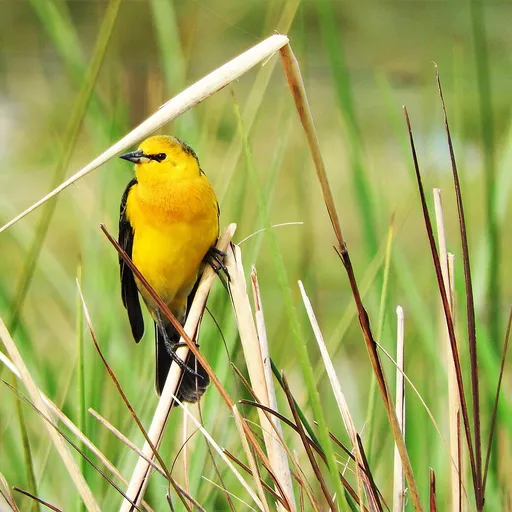
Saffron-cowled Blackbird
Xanthopsar flavus
Endangered
Listen
XC757629 · Belén y Diego · Pancho Cue, General Alvear, Corrientes, Argentina · CC0 1.0
Overview
The saffron-cowled blackbird (Xanthopsar flavus) is an endangered species of bird in the family Icteridae, native to southeastern South America. It is the sole member of its genus and is closely related to the two marshbirds in the genus Pseudoleistes.
Identification
- Males display black lores, hindcrown, nape, back, and tail, contrasting with yellow head, rump, and underparts that carry a tinge of orange on the forehead and breast.
- Females feature a brownish-gray stripe through the eye and brownish-gray crown, nape, back, wings, and tail, with the rest of the plumage appearing yellow.
- Both sexes possess a black bill, black legs and feet, and an orange-brown to deep red-brown iris.
- The song is described as brief and unmusical, starting with short whistled notes and ending with a rasping kluijjjjjj.
Habitat
Found in southeastern Paraguay, far southern Brazil, eastern Uruguay, and northeastern Argentina, this species inhabits a mosaic of marshes, wet grasslands, bogs, pastures, and agricultural fields such as rice paddies. It may also utilise habitats bordered by subtropical forest or bamboo, ranging from sea level to approximately 1,000 m in elevation.
Diet
This bird feeds primarily on insects and spiders, alongside a smaller intake of small vertebrates like frogs, with seeds forming only a minor part of its diet. It forages on the ground in flocks that 'roll' across the landscape, probing soil, plucking prey from low vegetation, and capturing winged ants in the air.
Did you know?
The species exhibits potential cooperative breeding behaviour, as some nests have been observed with two males attending. Additionally, it is a target of the illegal cage bird trade, which contributes to its declining population.
Sources
- Wikipedia · CC BY-SA 4.0
- Wikidata · CC0 1.0