
Sabine's Gull
Xema sabini
Least Concern
Listen
XC919304 · Sonothèque ADVL · Cap Lihou (Granville), Manche, Normandie, France · CC0 1.0
Overview
The Sabine's gull (Xema sabini) is a small gull that typically forms the only species within the genus Xema. It is classified as Least Concern on the IUCN Red List and is notable for its extensive migratory patterns between the Arctic and the Southern Hemisphere.
Identification
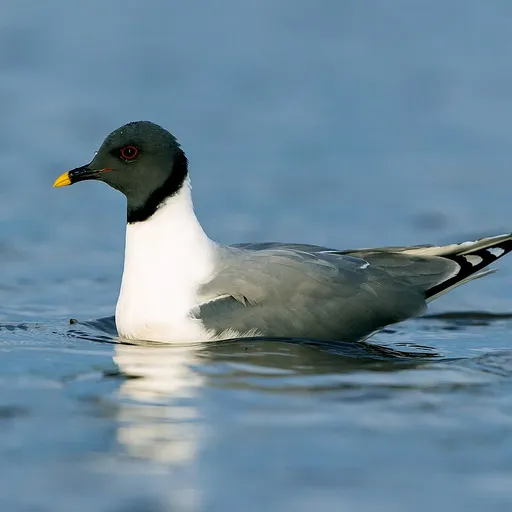
- Small gull measuring 27 to 33 cm in length with a black bill featuring a distinct yellow tip.
- Adult plumage includes a pale grey back and wing coverts, four black outer primary flight feathers, and white inner primaries and secondaries.
- Tail is white and slightly forked, while breeding adults develop a dark grey hood with a narrow black collar.
- Vocalisation is a very high-pitched and squeaking call.
Habitat
Breeds in colonies on Arctic coasts and tundra, often laying eggs in ground nests lined with grass. It is pelagic outside the breeding season, wintering in the cold waters of the Benguela Current off southwestern Africa or the Humboldt Current off the South American west coast.
Diet
Consumes a wide variety of mainly animal food, including insects, crustaceans, molluscs, and small fish. During the breeding season, it forages on the tundra and in boreal river deltas, and may opportunistically eat nestling birds or unhatched eggs.
Did you know?
This species exhibits the longest migration of any gull, covering up to 32,000–39,000 km per year between the Arctic and the Southern Hemisphere.
Sources
- Wikipedia · CC BY-SA 4.0
- Wikidata · CC0 1.0