
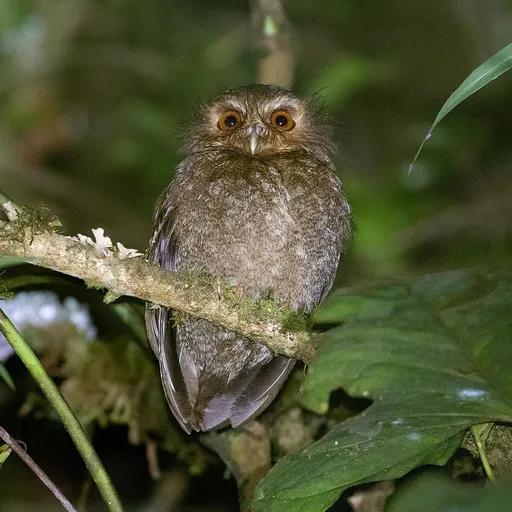
Long-whiskered Owlet
Xenoglaux loweryi
Vulnerable
Overview
The long-whiskered owlet, Xenoglaux loweryi, is a vulnerable species of owl endemic to a small area in the Amazonas and San Martín departments of northern Peru. It is one of the world's smallest owls and the only member of its genus.
Identification
- Size: Extremely small, measuring 13 to 14 cm in length with an average weight of 48 g.
- Plumage: Brown upperparts with tiny dull black bars; underparts brown with increasing white spots creating a salt-and-pepper appearance; throat and 'eyebrows' are buffish white.
- Facial features: Dull cinnamon brown ruff around the eyes with long, thin outer feathers projecting beyond the face.
- Call: A single, slightly hoarse hoot that rises then falls in pitch, often given in a series, or a rare rapid, low-pitched trill.
Habitat
Found in the Andes of northern Peru, inhabiting humid montane forest and elfin forest at elevations between 1,900 and 2,600 m. The habitat is characterised by fog-shrouded conditions heavy with moss, bromeliads, epiphytes, dense Chusquea bamboo thickets, and a thick layer of humus on the forest floor.
Diet
Diet and feeding behaviour have not been formally described, though one specimen's stomach contained insect remains.
Did you know?
The first sighting of this species in the wild was not until 2007, nearly 30 years after it was described from specimens collected in mist nets.
Sources
- Wikipedia · CC BY-SA 4.0
- Wikidata · CC0 1.0