
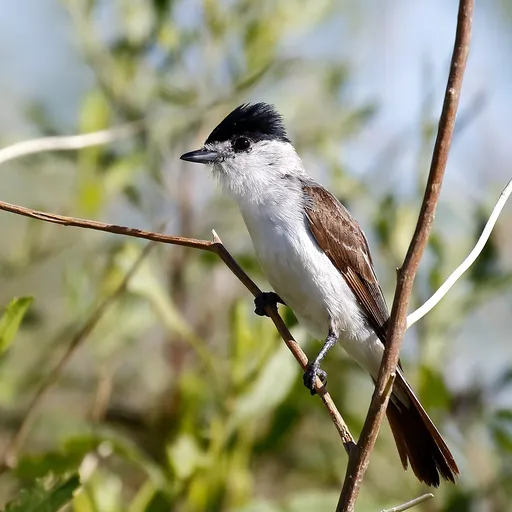
White-naped Xenopsaris
Xenopsaris albinucha
Least Concern
Overview
The white-naped xenopsaris, also known as the reed becard, is a small suboscine bird in the family Tityridae and the only member of its genus. It is found across South America, inhabiting open woodland and savanna climates east of the Andes, and is classified as least concern by the IUCN despite being uncommon in many areas.
Identification
- 12.5 to 13 cm in length with a glossy black crown, white nape and underparts tinged with grey and yellow, and grey-brown upperparts.
- Stout black bill and legs; females are duller with a chestnut-tinged crown.
- Song is delicate and consists of high-pitched, hesitant trills such as "teep, tre'e'e'e'e'a eea wu'u'u'e'e'e-e-e-e-e-p" or squeaky, undulating screeches.
Habitat
Found in humid subtropical and tropical savanna climates in most countries east of the Andes, including Venezuela, Brazil, Bolivia, Paraguay, Uruguay, and Argentina. It inhabits open woodlands, riverine scrubland, and areas with scattered trees, typically near water or damp locations at altitudes from sea-level to 550 m.
Diet
Feeds primarily on insects caught in tree foliage and sometimes on the ground, with chicks being fed grasshoppers, mantidflies, praying mantises, and mosquitoes. Foraging occurs singly or in pairs, involving launching from perches to snatch prey or hovering above vegetation, often while emitting an ascending "shreee" call.
Did you know?
While generally shy and inconspicuous, the species becomes very tame during the brooding period, remaining on the nest even when researchers approach within centimetres, though it will aggressively attack animals that threaten the nest.
Sources
- Wikipedia · CC BY-SA 4.0
- Wikidata · CC0 1.0