
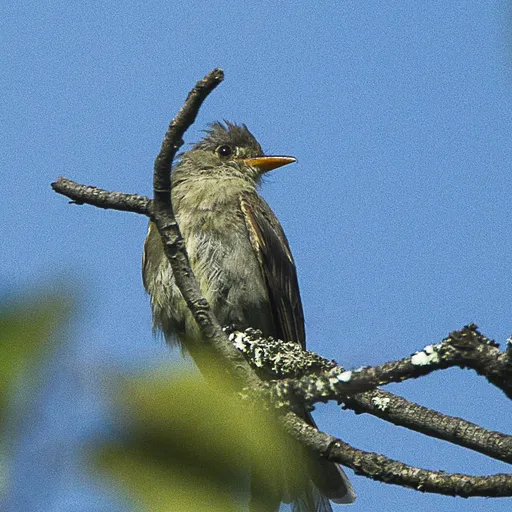
Pileated Flycatcher
Xenotriccus mexicanus
Least Concern
Overview
The pileated flycatcher is a monotypic species of tyrant flycatcher endemic to Mexico. Classified as Least Concern by the IUCN, it is one of only two members of the genus Xenotriccus. The estimated population of 20,000 to 50,000 mature individuals is believed to be decreasing due to agricultural expansion.
Identification
- A stocky bird measuring 13.5 to 14.5 cm in length, distinguished by a pointed greyish or olive-brown crest that is usually held erect.
- Features a white teardrop-shaped eye-ring, pale lores, and a white throat that transitions to a grey-olive washed breast and a yellow-tinged belly.
- Displays two whitish wing bars formed by coverts, dark wings with whitish secondary edges, and a dark, dusky tail.
- The song is a sputtered, intensifying sequence reminiscent of a sport referee's whistle, such as 'p'iweer pi-pi-pirrr-i-it cheeu', while calls include nasal 'brree' notes and explosive 'cheeoo' or 'cheeup' sounds.
Habitat
Found in southwestern Mexico from central Michoacán and Morelos southeast to the Isthmus of Tehuantepec in Oaxaca, it primarily inhabits arid scrublands, especially mesquite and thorn forest, and occasionally open over-grazed areas. It also occurs in pine-oak, oak, and fir forests at elevations ranging between 900 and 2,000 m, with records up to 3,000 m.
Diet
The pileated flycatcher feeds on insects, though specific details are lacking. It forages by sitting somewhat erect on a low perch and making sallies to capture prey in mid-air or snatch it from foliage.
Did you know?
The species' original type specimen was misidentified as a western wood pewee, leading to its initial description under the genus Aechmolophus before it was merged into Xenotriccus in 1977. Its nest is an open cup constructed from fine grasses and plant fibres bound with spider web and placed within a thorny thicket.
Sources
- Wikipedia · CC BY-SA 4.0
- Wikidata · CC0 1.0