
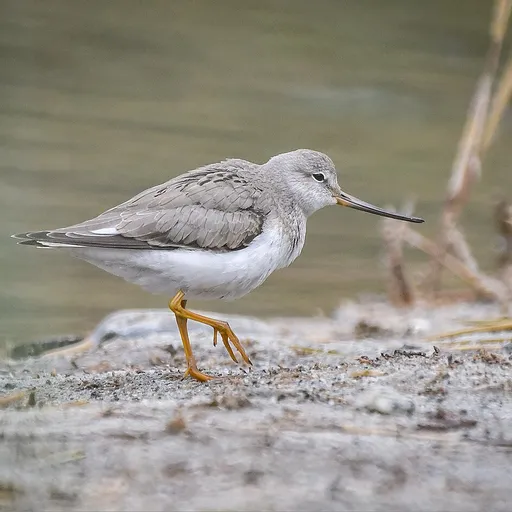
Terek Sandpiper
Xenus cinereus
Least Concern
Listen
XC926291 · Jochem Verweij · Ögiy, O'giinuur, Arkhangai, Mongolia · CC BY-SA 4.0
Overview
The Terek sandpiper (Xenus cinereus) is a small migratory Palearctic wader and the sole member of the genus Xenus. Named after the Terek River flowing into the Caspian Sea, where it was first observed, it is currently classified as Least Concern on the IUCN Red List.
Identification
- Slightly larger than the common sandpiper, measuring 22–25 cm in length.
- Possesses a long, upcurved bill that is reminiscent of an avocet's, with a yellowish base and black remainder.
- Displays a grey back, face, and breast in all plumages, with a white belly and yellow feet.
- Features a high whistle as its call.
Habitat
Breeding near water in the taiga from Finland through northern Siberia to the Kolyma River, it migrates south in winter to tropical coasts in east Africa, south Asia, and Australia, usually preferring muddy areas. It is a rare vagrant in western Europe and occasionally strays to Alaska, the Aleutian Islands, and the Neotropics.
Diet
It feeds in a distinctive and very active manner, chasing insects and other mobile prey. It sometimes runs to the water's edge to wash its catch after capturing it.
Did you know?
The genus name Xenus is derived from the Ancient Greek word for 'stranger'. It is also known to associate with ruddy turnstones, small calidrids, and plovers, with one vagrant bird even recorded pairing with a spotted sandpiper in Rio de Janeiro.
Sources
- Wikipedia · CC BY-SA 4.0
- Wikidata · CC0 1.0