
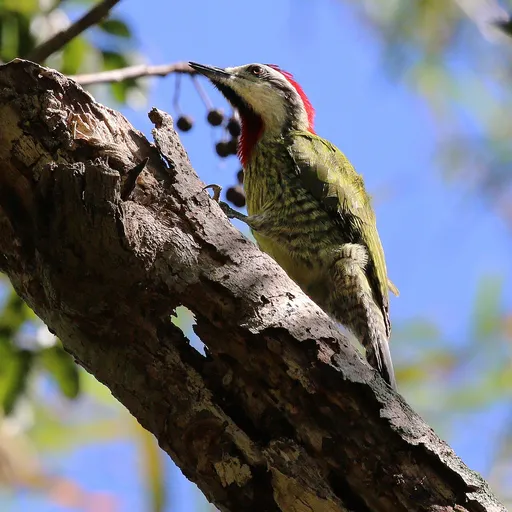
Cuban Green Woodpecker
Xiphidiopicus percussus
Least Concern
Overview
The Cuban green woodpecker (Xiphidiopicus percussus) is a medium-sized woodpecker and one of only two species endemic to Cuba. It is the island's most widespread and common woodpecker, classified as Least Concern on the IUCN Red List.
Identification
- Olive green upperparts and yellow, streaked underparts, with a bright red upper breast and black chin contrasting a white face.
- Males feature a red crown, whereas females have black crowns with white stripes; females are generally smaller than males.
- Measures 21 to 25 cm in length with a short, straight beak that darkens progressively from base to tip.
- Distinctive call described as a short, harsh 'jhhhorr, jhhhorr, jhhhorr' or a higher-pitched 'yeh-yeh-yeh.'
Habitat
Endemic to Cuba, this species inhabits a variety of environments including wet and dry forests, mangroves, open woodlands with palms, pine forests, and lowland moist forests. It also occupies heavily degraded former forest areas and is found across various archipelagos within the Cuban region.
Diet
Primarily an insectivore focusing on large insects, but also consumes fruits, small frogs, flower nectar (especially from Cordia sebestena), and occasionally the eggs of other birds such as herons. The bird acts as a pollinator by inserting its bill into floral tubes to drink nectar. Males and females utilise different methods to exploit food sources due to size differences.
Did you know?
By inserting its bill into the floral tubes of Cordia sebestena to drink nectar, the woodpecker comes into contact with the anthers and stigma, effectively acting as a pollinator for the plant.
Sources
- Wikipedia · CC BY-SA 4.0
- Wikidata · CC0 1.0