
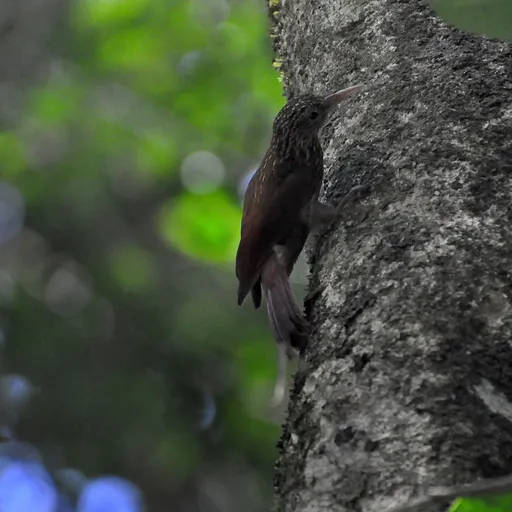
Elegant Woodcreeper
Xiphorhynchus elegans
Least Concern
Listen
XC248735 · Niels Krabbe · Sucumbíos: 'La Selva Jungle Lodge', n bank Río Napo, Ecuador · CC BY-SA 4.0
Overview
The elegant woodcreeper (Xiphorhynchus elegans) is a medium-sized member of the ovenbird family Furnariidae. It is a year-round resident found in the humid forests of South America, classified as a species of Least Concern by the IUCN.
Identification
- Size and Bill: 18 to 22.5 cm in length, with a longish, slim, and nearly straight bill; the maxilla is dark brown to black, and the mandible is gray to bluish-gray with a brownish tip.
- Plumage: Sexes share identical plumage; the nominate subspecies features a blackish-brown face with bold buff streaks, whitish lores, and a pale supercilium, along with a darker olive-brown crown and nape marked with buff spots edged in blackish.
- Underparts and Wings: The breast and sides are grayish olive-brown with buffy teardrops or chevrons edged in blackish, while the wings, rump, and tail are cinnamon-rufous to rufous-chestnut with darker primary tips.
- Vocalisation: Sings mostly at dawn and dusk, producing a descending series of roughly 30 ringing whistles that begin softly and slow at the end, described as "whit, whit, wit, wit, wit...wit, wit, wee, wee, wee, wit, wit, wit, wit, wew".
Habitat
Primarily inhabits humid evergreen forest, favouring terra firme and floodplains, though it occasionally occurs in seasonally flooded várzea and igapó forest or on river islands. Its range spans Bolivia, Brazil, Colombia, Ecuador, and Peru, generally found below 600 m but reaching 1,500 m on eastern Andean slopes.
Diet
Diet consists mostly of arthropods, occasionally supplemented by small vertebrates. It forages in mixed-species flocks, often led by Thamnomanes antshrikes, hitching up and along trunks and branches to glean prey or peck from bark crevices, dead leaves, and epiphytes between the understory and 20 m above the ground.
Did you know?
The elegant woodcreeper infrequently follows army ant swarms, foraging near the ground by pecking prey from trunks or sallies from a perch.
Sources
- Wikipedia · CC BY-SA 4.0
- Wikidata · CC0 1.0