
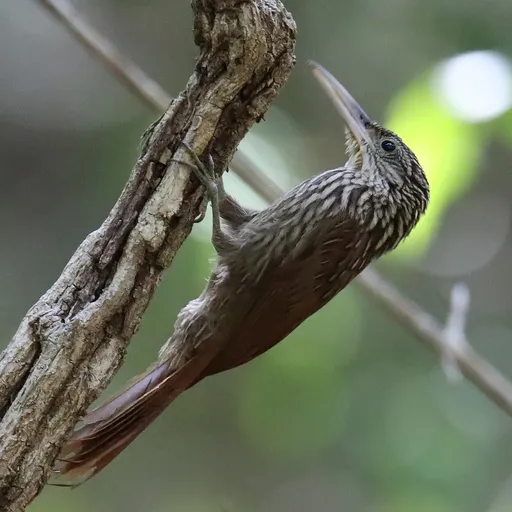
Ivory-billed Woodcreeper
Xiphorhynchus flavigaster
Least Concern
Listen
XC495430 · Oliver Komar · San Antonio de Oriente, Departamento de Francisco Morazán, Honduras · CC BY-SA 4.0
Overview
The ivory-billed woodcreeper (Xiphorhynchus flavigaster) is a species of bird in the ovenbird family Furnariidae. It is a medium-sized member of the genus Xiphorhynchus that is considered fairly common across its extensive range, despite a decreasing population trend.
Identification
- Medium-sized bird measuring 20 to 26.5 cm in length with a long, fairly heavy, slightly decurved bill that is pale with a brownish or bluish base.
- Plumage features a dark grayish brown crown and nape with buff spots, olive-brown back with blackish-edged buff streaks, and chestnut rump, tail, and wings.
- Underparts are light buffy brown with dusky-edged streaks, while the throat is buffy with thin dusky streaks and the upper breast has a scaly appearance.
- Song varies by region, described as piercing whistles in loud cascades in western Mexico, a rapid descending trill in northern Central America, and a loud, laughing, descending whinny in Costa Rica.
Habitat
Found in Belize, Costa Rica, El Salvador, Guatemala, Honduras, Mexico, and Nicaragua, the species inhabits a variety of forested landscapes including deciduous and semi-deciduous forests, gallery forests, pine-oak woodlands, and mangroves. It tends to favour drier landscapes than many other woodcreepers and usually occurs between sea level and 1,500 m elevation, though locally it can be found up to 2,900 m.
Diet
The diet consists mostly of arthropods, but also includes invertebrates such as snails and small vertebrates like lizards. It usually forages singly or in pairs from the mid-level to the subcanopy by probing bark crevices, bromeliads, and epiphytes, and occasionally flakes off bark. It also joins mixed-species flocks and follows army ant swarms, perching low or dropping to the ground to catch disturbed prey.
Did you know?
Although it is a woodcreeper, this species is a generalist that is far less dependent on true forest than most of its relatives, showing only moderate sensitivity to human disturbance provided that patches of forest remain. It is also notable for its ability to hitch up trunks in a spiral and even forage on the underside of branches.
Sources
- Wikipedia · CC BY-SA 4.0
- Wikidata · CC0 1.0