
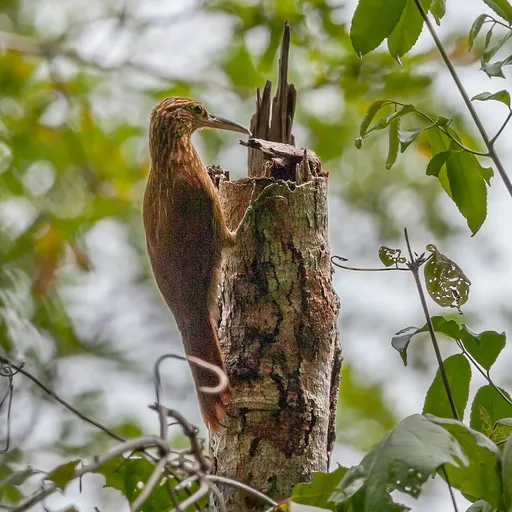
Buff-throated Woodcreeper
Xiphorhynchus guttatus
Least Concern
Listen
XC248729 · Niels Krabbe · Sucumbíos: 'La Selva Jungle Lodge', n bank Río Napo, Ecuador · CC BY-SA 4.0
Overview
The buff-throated woodcreeper (Xiphorhynchus guttatus) is the largest member of its genus and is classified as Least Concern on the IUCN Red List. It is a bird in the ovenbird family Furnariidae, found across a wide range in South America.
Identification
- Measures 22.5 to 29.5 cm in length with a heavy body and a long, heavy, decurved bill.
- Adults of the nominate subspecies have a dark brown face with narrow whitish buff streaks and a deep buff throat.
- Underparts are reddish brown with black-edged deep buff streaks that narrow on the belly, while the rump and tail are cinnamon-rufous to rufous-chestnut.
- The bill is dark brownish black with a paler culmen, and legs are blue, greenish gray, or dark gray.
Habitat
Inhabits humid evergreen forest, though specific details vary by subspecies, including semi-deciduous forest, gallery forest, and palm swamps. Populations in the Amazon Basin inhabit terra firme and seasonally flooded forests, while others favour edges, gaps, and older secondary forest. Most individuals occur between sea level and 800 m, though some subspecies reach elevations of up to 1,250 m.
Diet
The diet consists mostly of arthropods but occasionally includes small vertebrates. It forages singly or in pairs, hitching up trunks and branches to glean and peck for prey on palm fronds, dead leaf clusters, and arboreal termite nests. It regularly follows army ant swarms, making sallies from perches to glean from the ground and foliage.
Did you know?
The species nests in cavities in dead trees, either natural ones or those excavated by woodpeckers. Despite its large range, population sizes are not known and are believed to be decreasing.
Sources
- Wikipedia · CC BY-SA 4.0
- Wikidata · CC0 1.0