
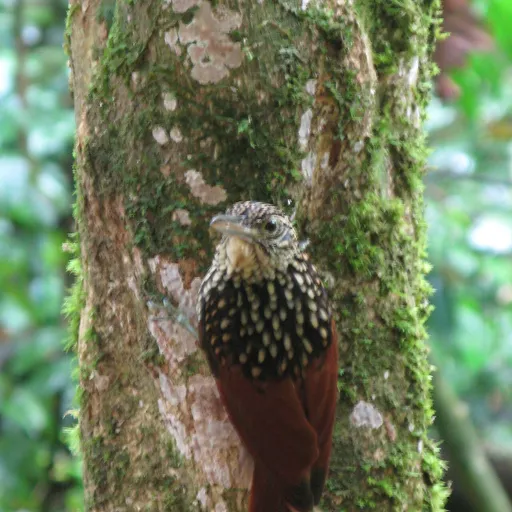
Black-striped Woodcreeper
Xiphorhynchus lachrymosus
Least Concern
Listen
XC248289 · Niels Krabbe · Esmeraldas: right bank Rio Santiago, above Estero Pote 7 km E Playa de Oro, Ecuador · CC BY-SA 4.0
Overview
The black-striped woodcreeper (Xiphorhynchus lachrymosus) is a medium-sized bird in the ovenbird family Furnariidae. It is a year-round resident found across Central and northern South America, classified as Least Concern by the IUCN despite a believed decreasing population.
Identification
- A medium-sized bird measuring 21.5 to 25 cm in length, with a longish, nearly straight bill featuring a slight droop at the tip.
- Adults display a brownish black face with buff streaks, and a crown and nape marked with buffy teardrop spots and wide streaks.
- The back is brownish black with buff streaks, while the lower back, rump, and wings are dark cinnamon-rufous, with a rufous-chestnut tail.
- The song consists of clear whistles that begin slowly, speed up, and then slow down, described as "wi, di, di, di, di-di-di-di-di-di, di, di, dew".
Habitat
Found in Colombia, Costa Rica, Ecuador, Nicaragua, and Panama, this species mostly inhabits humid lowland forest, favouring evergreen forest but also extending into mangroves. It prefers the interior of tall mature forest but is regular at its edges and gaps, as well as in older secondary forest and occasionally in tree plantations. Elevation ranges mostly between sea level and 1,000 m, though it reaches up to 1,500 m in Costa Rica and Colombia.
Diet
The diet consists mostly of arthropods, but also includes small vertebrates such as lizards. It usually forages singly, though sometimes in pairs or family groups, and occasionally joins mixed-species feeding flocks, feeding in the canopy with these groups. Foraging involves hitching up trunks and along branches, probing bark crevices, vine tangles, and dead leaf clusters, and it regularly follows army ant swarms.
Did you know?
The bird's combination of size and pattern of pale buff and black streaks is unique among woodcreepers. While it nests in a tree or palm cavity lined with wood and bark chips, details regarding the incubation period, time to fledging, and parental care remain unknown.
Sources
- Wikipedia · CC BY-SA 4.0
- Wikidata · CC0 1.0