
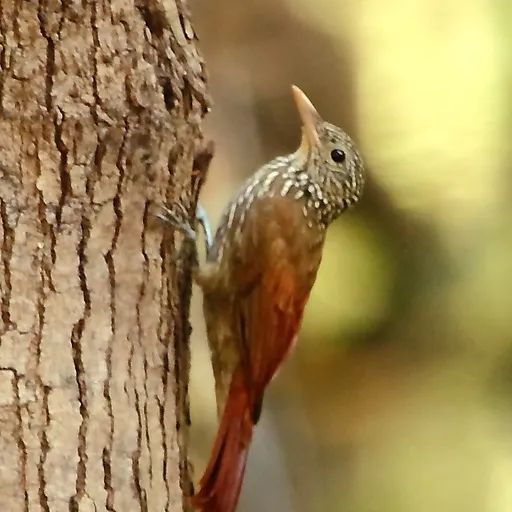
Striped Woodcreeper
Xiphorhynchus obsoletus
Least Concern
Listen
XC248799 · Niels Krabbe · Orellana: Laguna Añangu ('Napo Wildlife Center'), s-bank Río Napo, Ecuador · CC BY-SA 4.0
Overview
The striped woodcreeper (Xiphorhynchus obsoletus) is a medium-sized bird in the ovenbird family Furnariidae. It is a year-round resident across various parts of South America and is currently assessed as Least Concern by the IUCN.
Identification
- A medium-sized bird measuring 18 to 20.5 cm in length, with a slim, slightly decurved bill.
- Adults feature a face with thin creamy buff and dark brown streaks that transition into bold scaling on the sides of the neck.
- The back is olive-brown with dusky-edged whitish buff streaks, while the rump, wings, and tail are cinnamon-rufous to rufous-chestnut.
- The song consists of a trill of 20–35 sharp notes that stutter before speeding up and rising, described as 'che-e-e-e-e-e-ee-ie-ie-iek!'.
Habitat
This species primarily inhabits mature evergreen forests and favours landscapes near water, such as várzea, igapó, swamp forest, and river islands. It is entirely a bird of the lowlands, found only below 500 m, and occurs in gallery forest within the cerrado in the southern part of its range.
Diet
The diet consists mainly of insects and other arthropods like spiders, foraged singly or in pairs at all forest levels up to the subcanopy. The bird hitches up trunks and branches to glean, probe, and peck for prey, while also capturing a significant portion of its food via mid-air sallies from a perch.
Did you know?
The striped woodcreeper is not known to follow army ant swarms, instead sometimes joining mixed-species feeding flocks for its insectivorous meals.
Sources
- Wikipedia · CC BY-SA 4.0
- Wikidata · CC0 1.0