
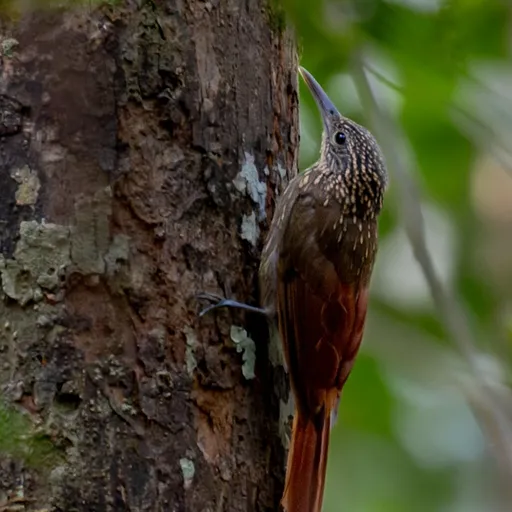
Chestnut-rumped Woodcreeper
Xiphorhynchus pardalotus
Least Concern
Overview
The chestnut-rumped woodcreeper is a species of bird in the subfamily Dendrocolaptinae of the ovenbird family Furnariidae. It is a year-round resident throughout its range and is classified as Least Concern by the IUCN.
Identification
- Medium-sized bird, 20 to 23.5 cm long, with a longish, slim, slightly decurved bill.
- Face is mostly thin deep buff with brown streaks, featuring a buff supercilium and eyering.
- Rump, wings, and tail are rufous-chestnut, while the crown and nape are blackish brown with deep buff spots.
- Legs and feet are bluish gray or gray; males and females share the same plumage.
- Song includes phrases like "chip!, chip, chip, chi-i-i-i-i-i-i-ip" and calls are unstructured series of chirps such as "ik" and "chip".
Habitat
Found in Brazil, French Guiana, Guyana, Suriname, and Venezuela, primarily inhabiting lowland evergreen forest and the lower elevations of montane forest in the tepui region. It favors the interior of mature terra firme forest but also occurs at its edges, in mature secondary forest, and less often in floodplain forest and wooded savanna. The species typically ranges up to 500 m in elevation but reaches 1,800 m on the tepuis.
Diet
Feeds mostly on arthropods, foraging from the understory to the canopy by hitching up and along trunks and branches. It captures prey by gleaning and probing bark crevices, clusters of dead leaves, epiphytes, and dead wood, and sometimes follows army ant swarms to catch disturbed insects.
Did you know?
It is considered highly sensitive to loss and fragmentation of forest, similar to most flocking and ant-following species. Breeding mostly occurs in the dry season between September and January, with nests consisting of natural tree or stump cavities lined with bark chips.
Sources
- Wikipedia · CC BY-SA 4.0
- Wikidata · CC0 1.0