
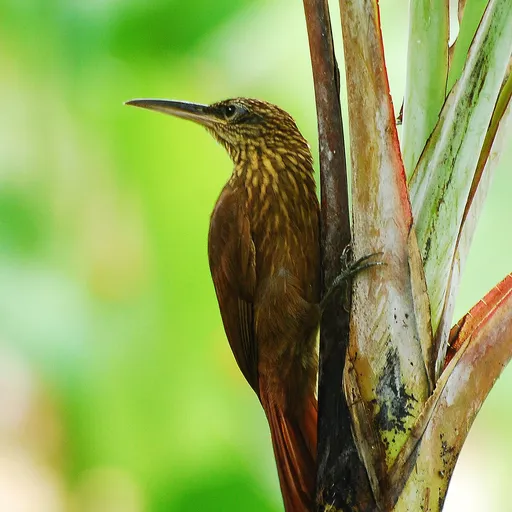
Cocoa Woodcreeper
Xiphorhynchus susurrans
Least Concern
Overview
The cocoa woodcreeper (Xiphorhynchus susurrans) is a medium-sized bird in the ovenbird family Furnariidae, formerly considered part of the buff-throated woodcreeper but recognised as a separate species since the 1990s. It is a year-round resident across a wide range in the Americas and is currently assessed as Least Concern by the IUCN.
Identification
- Medium-sized bird measuring 21 to 25.5 cm in length with a long, fairly heavy, slightly decurved bill that is mostly black.
- Plumage varies by subspecies, but adults typically feature a dusky face with buff streaks, a whitish supercilium, and a dark crown with longish buff spots.
- Upperparts are olive-brown to brown with blackish-edged buff streaks, while the rump, tail, and flight feathers are rufous-chestnut.
- Underparts range from grayish olive to buffy brown, with reddish-brown breasts and bellies that may display dusky-edged spots or thin streaks depending on the subspecies.
- Vocalisations include a loud series of 7-20 upward-inflected whistles, such as "ki, ki, kuee, kuee, whe, whew", and a long call resembling steady rolling laughter.
Habitat
Found in Colombia, Costa Rica, Guatemala, Honduras, Nicaragua, Panama, Trinidad and Tobago, and Venezuela, the species mostly inhabits humid evergreen forest, including gallery forest, deciduous woodland, and forest edges. It generally occurs below 900 m but can reach higher elevations in specific regions and is often found in secondary growth or near human disturbances.
Diet
The diet consists primarily of arthropods, occasionally supplemented by small vertebrates such as frogs and lizards. The bird forages by gleaning from bark crevices, probing dead leaves and epiphytes, or following army ant swarms, often hitching up trunks in a spiral or along the undersides of branches.
Did you know?
While the cocoa woodcreeper typically nests in natural cavities, it has been observed to utilise human structures for nesting, adding bits of bark, wood chips, and softer plant material to these artificial spaces.
Sources
- Wikipedia · CC BY-SA 4.0
- Wikidata · CC0 1.0