
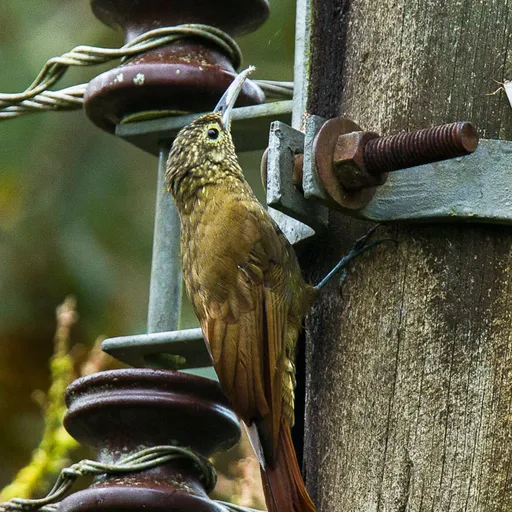
Olive-backed Woodcreeper
Xiphorhynchus triangularis
Least Concern
Listen
XC251788 · Niels Krabbe · Zamora-Chinchipe: Reserva Tapichalaca, near Q. Cristopher Parson, Ecuador · CC BY-SA 4.0
Overview
The Xiphorhynchus triangularis is a medium-sized bird in the ovenbird family Furnariidae, native to the Andean forests of South America. Assessed as Least Concern by the IUCN, its population is believed to be decreasing despite a lack of identified immediate threats.
Identification
- Males and females share the same plumage, featuring a finely streaked face with a buffy supercilium and a blackish-brown crown with pale spots.
- The back is bright olive to brownish olive, contrasting with cinnamon to rufous-chestnut tail coverts and a dark rufous-chestnut tail.
- Underparts are a slightly lighter olive, marked with buffy whitish spots that become more triangular on the belly.
- The bill is slightly decurved, and the legs are blue-gray to gray with a faint olive cast.
- The song is a series of hard notes that accelerate and slow, transcribed as 'we we we-we-we-we-we-WE-WE-We-we-wa'.
Habitat
This species inhabits the middle elevations of the Andes across Bolivia, Colombia, Ecuador, Peru, and Venezuela. It primarily occupies humid evergreen montane forest and cloud forest, favoring the interior of mature primary forest while occasionally using edges and secondary growth. Elevation ranges typically between 1,000 and 2,400 m, though it reaches as high as 2,700 m and as low as 400 m in specific regions.
Diet
Although the specific diet is not fully detailed, it is believed to consist mostly of arthropods. Foraging is typically conducted singly or in pairs, hitching up and along trunks, vines, and large branches from the mid-level to the subcanopy. Much of its prey is extracted from clumps of moss, bark crevices, and epiphytes.
Did you know?
The species is largely restricted to mature forest and is believed to be highly sensitive to human disturbance, making it a key indicator of pristine forest health. Despite this sensitivity, it remains a year-round resident throughout its wide Andean range.
Sources
- Wikipedia · CC BY-SA 4.0
- Wikidata · CC0 1.0