
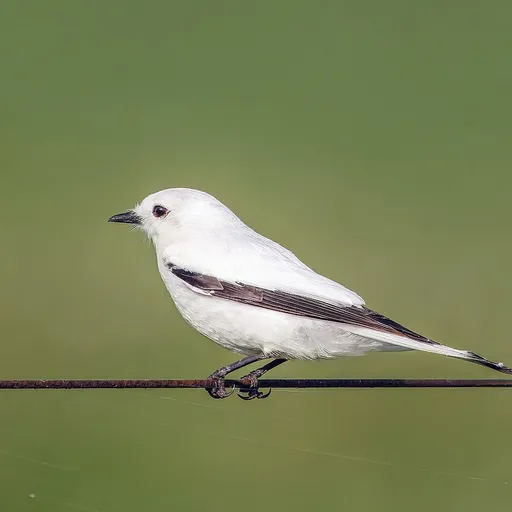
White Monjita
Xolmis irupero
Least Concern
Overview
The white monjita (Xolmis irupero) is a species of bird in the family Tyrannidae, the tyrant flycatchers. It is distributed across Argentina, Bolivia, Brazil, Paraguay, and Uruguay, and is currently assessed as Least Concern on the IUCN Red List.
Identification
- Adults are almost entirely white, 17 to 18 cm long, with black primaries, primary coverts, and tail tips; females possess a slight grey tinge on the back.
- Subspecies X. i. niveus is slightly smaller than the nominate and features a wider black band on the tail.
- Both sexes have a dark brown iris, a black bill, and black legs and feet.
- The male's dawn song consists of a soft, repeated "preeeyp tooit preeeyp tooit", along with weak ghiks and a whining piew.
Habitat
The species inhabits open and semi-open landscapes such as savannas, grasslands, and pastures with scattered bushes and trees, usually near marshes or water. It often occurs around isolated human dwellings and along roads, reaching elevations of approximately 1,000 m, or up to 1,300 m in Bolivia. Its distribution is disjunct, with the nominate subspecies ranging from central Bolivia to southern South America, while X. i. niveus is found in northeastern Brazil.
Diet
The white monjita feeds on insects, foraging by perching visibly in open areas on treetops, wires, and bushes. It drops from these perches to the ground to capture prey and occasionally hovers before descending, moving into dense vegetation only if threatened.
Did you know?
Shiny cowbirds (Molothrus bonariensis) are known to parasitise the nests of the white monjita, which are often placed in hollows of trees or in abandoned furnariid ovenbird nests.
Sources
- Wikipedia · CC BY-SA 4.0
- Wikidata · CC0 1.0