
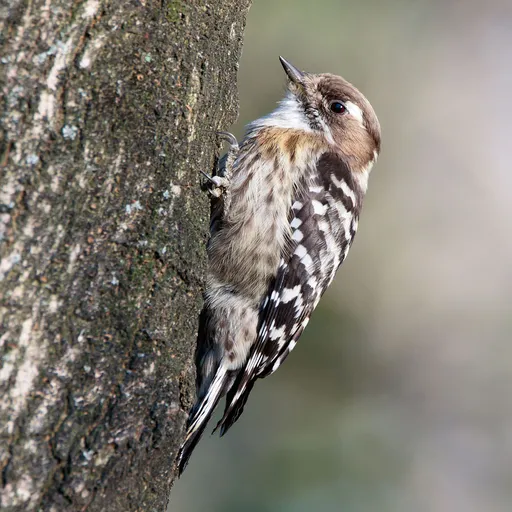
Japanese Pygmy Woodpecker
Yungipicus kizuki
Overview
The Japanese pygmy woodpecker, Yungipicus kizuki, is a species of woodpecker found in coniferous and deciduous forests across East Asia. The species has been assessed by the IUCN as least concern due to its large range and stable population.
Identification
- Length of 13–15 cm with a grey-brown crown and white supercilium extending to the neck and breast.
- Mantle and back are dark brown with white bars; breast, flanks, and belly feature variable streaks.
- Male has a small red mark on the side of the nape, while the female lacks this marking and possesses longer beak, wings, and tail.
- High-pitched "tsi-tsi-tsi" call and a quick drumming display.
Habitat
Found in Korea, northeastern China, southeastern Siberia, Sakhalin, Japan, and the Ryukyu Islands. It inhabits lowland, upland, and riverine coniferous and deciduous forests, as well as parks and gardens, reaching elevations of up to 2,100 m.
Diet
Forages in trees for invertebrates including spiders, caterpillars, ants, and aphids, as well as berries. It typically occurs in pairs or mixed-species foraging flocks.
Did you know?
Breeding begins in March in southern Japan but not until late May in northern regions, with five to seven white eggs incubated for 12 to 14 days before fledging occurs after three weeks.