
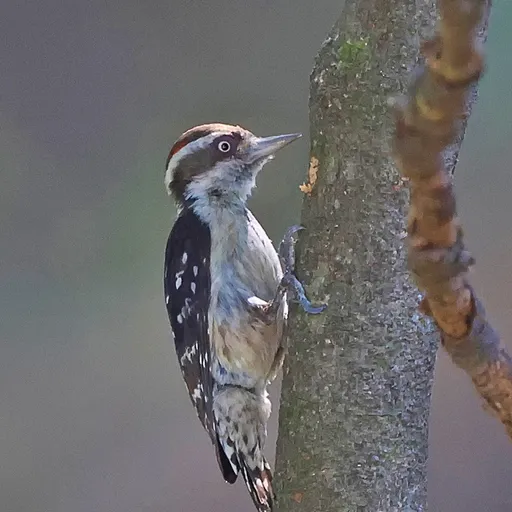
Brown-capped Pygmy Woodpecker
Yungipicus nanus
Overview
The brown-capped pygmy woodpecker, also known as the Indian pygmy woodpecker, is a very small, non-migratory species found in Nepal, India, and Sri Lanka. It is often observed in pairs or small family groups and is recognised for its high level of activity within the tree canopy.
Identification
- A small brown and white bird featuring a brownish cap that extends from the forehead to the hindneck.
- Distinguished by pink-rimmed white irises.
- Plumage is barred brown and white above, with a lightly streaked dirty white underside and a tail spotted with white.
- Males display a paler brown crown edged in red, contrasting with white supercilia and cheeks.
- Vocalisation consists of a weak, rapid, rattling sound on a rising scale lasting between 1.2 and 1.5 seconds.
Habitat
This resident species is found across most of India (excluding the northeast and Thar desert), Nepal, and Sri Lanka. It inhabits diverse environments up to 2300m elevation, including deciduous and secondary forests, orchards, mangroves, and urban gardens. Birds at higher altitudes may move to lower elevations during the winter months.
Diet
Feeding on small invertebrates, nectar, and fruit, the bird forages by gleaning and probing wood. It is highly active and often forages in pairs or mixed-species flocks within the canopy.
Did you know?
Although it is a territorial and monogamous species that nests in tree cavities, it is rarely observed despite its constant foraging, largely because it remains hidden within the tree canopy. Both sexes actively participate in excavating nesting holes, which are situated 2–14 meters high in dead branches with a 3 cm entrance diameter.