
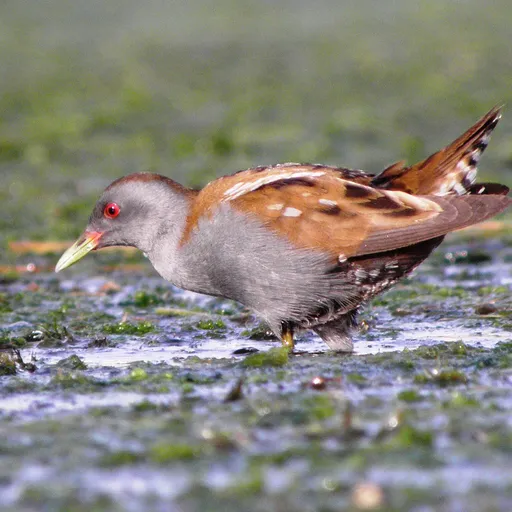
Little Crake
Zapornia parva
Least Concern
Listen
XC648398 · Jens Loose · Meißen (near Tauscha), Sachsen, Germany · CC BY-SA 4.0
Overview
The little crake is a very small waterbird of the family Rallidae, classified as Least Concern on the IUCN Red List. It is a migratory species that breeds in Europe and western Asia before wintering in Africa.
Identification
- 17–19 cm in length, slightly smaller than the spotted crake, and distinguished by the lack of dark barring and white spots on the flanks.
- Short, straight bill that is yellow with a red base, along with green legs featuring long toes.
- Adults exhibit strong sexual dimorphism: males have mainly brown upperparts with a blue-grey face and underparts, while females have buff underparts and a grey face.
- Immature birds resemble females but possess a white face and breast; downy chicks are black like all rails.
Habitat
Breeding habitats consist primarily of reed beds in Europe, mainly in the east, and just into western Asia. The species is migratory, with populations wintering in Africa.
Diet
These birds forage by probing with their bill in mud or shallow water and by picking up food by sight. Their diet mainly consists of insects and aquatic animals.
Did you know?
Although very secretive and mostly heard rather than seen during the breeding season, they become noisy birds on migration, producing a yapping 'kua' call. Their name derives from the Latin word parva, meaning 'small'.
Sources
- Wikipedia · CC BY-SA 4.0
- Wikidata · CC0 1.0