
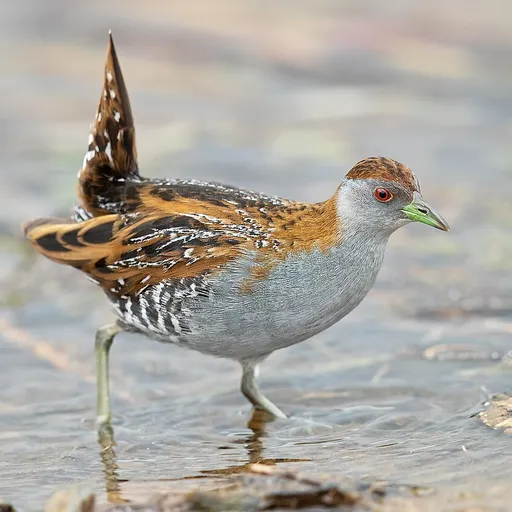
Baillon's Crake
Zapornia pusilla
Least Concern
Listen
XC730499 · Sonothèque ADVL · Carolles, Manche, Normandie, France · CC0 1.0
Overview
Baillon's crake (Zapornia pusilla), also known as the marsh crake, is a small waterbird of the family Rallidae. The species is named after French naturalist Louis Antoine François Baillon, and its scientific name pusilla derives from the Latin for 'very small'.
Identification
- Length of 15–18 cm with a short, straight bill that is yellow or green without a red base.
- Adults feature ochre-brown upperparts streaked with black and white, and light blue-grey underparts that are paler on the throat, breast, and abdomen.
- Flanks and under-tail coverts are barred black and white, supported by olive-green legs with long toes.
- Immatures resemble adults but have extensively barred, duller underparts, while chicks are black.
Habitat
Breeding habitat consists of sedge beds and swamps, ranging from Eastern Europe to Honshu in Japan. The species is migratory, wintering in East Africa and South Asia, while also acting as a resident breeder in Africa and Australasia.
Diet
These birds probe with their bill in mud or shallow water and also pick up food by sight. They mainly eat insects and aquatic animals.
Did you know?
Baillon's crakes are so secretive during the breeding season that they are mostly heard rather than seen, emitting a noisy, rattling call similar to that of an edible frog or a garganey. A single record of the species in North America was made on Attu Island in September 2000.
Sources
- Wikipedia · CC BY-SA 4.0
- Wikidata · CC0 1.0