
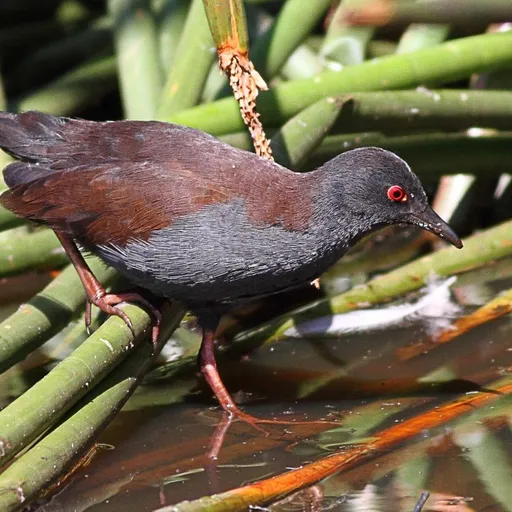
Spotless Crake
Zapornia tabuensis
Least Concern
Listen
XC842752 · Rob · Minnippi Parkland (near Tingalpa), Brisbane City, Queensland, Australia · CC BY 4.0
Overview
The spotless crake (Zapornia tabuensis) is a widely distributed bird in the rail family, Rallidae. Found across the southern Pacific Ocean, its range extends from the Philippines and New Guinea to New Zealand and the Marquesas Islands.
Identification
- Adults reach a length of 17–20 cm with a wingspan of 26–29 cm and weigh between 40–50 g.
- The head and neck are bluish-grey, while the back and wings are dark reddish-brown fading to a blackish-brown tail.
- The bill is black, the eyes are a deep red, and the legs and feet are reddish-pink.
- The high-pitched 'purr' call, consisting of rapid notes at roughly 25 per second, is believed to be its song.
Habitat
Spotless crakes are freshwater wetland birds that prefer dense vegetation in swamp areas, particularly raupo, flax, tussock sedge, and cabbage trees. They range from the Philippines through New Guinea and Australia to New Zealand and the South Pacific, though in New Zealand they are rare on the South Island due to competition with marsh crakes.
Diet
As an omnivorous species, the spotless crake feeds on seeds, fruits, grass shoots, aquatic leaves, insects, mollusks, crustaceans, spiders, and worms. They forage on open muddy areas near dense vegetation, retreating into cover when disturbed.
Did you know?
To distract mammalian predators such as cats, spotless crakes may feign injury while tending to their nests or chicks.
Sources
- Wikipedia · CC BY-SA 4.0
- Wikidata · CC0 1.0