
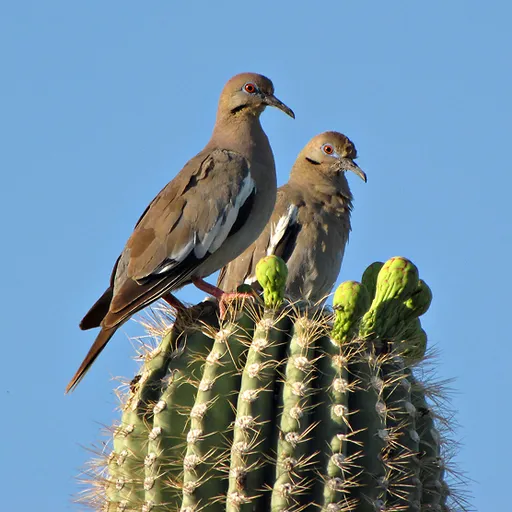
White-winged Dove
Zenaida asiatica
Least Concern
Overview
The Zenaida asiatica, or white-winged dove, is a plump, medium-sized dove native to the Southwestern United States, Mexico, Central America, and the Caribbean. Considered a species of least concern by the IUCN, it has adapted well to human environments, expanding its range due to agricultural development and urbanisation.
Identification
- Plumage and Markings: Brownish-grey to grey overall with a bold white wing patch that appears as a brilliant white crescent in flight; adults possess a long, dark mark on the lower face, while juveniles are duller in colour.
- Eyes and Legs: Adults have bright crimson eyes with a ring of blue featherless skin, and legs that are a brighter pink/red; juveniles have brown eyes and lack iridescence.
- Size and Build: Large for a dove, measuring 29 cm in length with a wingspan of 48–58 cm; features a short, rounded tail, distinguishing it from the long-tailed mourning dove.
- Vocalisation: Produces a call described as hhhHEPEP pou poooo, likened to the phrase "who cooks for you", which is most frequent during the breeding season.
Habitat
The species inhabits diverse environments including scrub, woodlands, desert, and urban or cultivated areas. Its historical range closely mirrored the distribution of the saguaro cactus, but the advent of agriculture has greatly expanded its range, allowing it to thrive in areas where it was previously absent.
Diet
Primarily granivorous, feeding on seeds, grains, and fruits, with Western subspecies relying heavily on pollen, nectar, and fruit from the saguaro cactus. They are known to visit bird feeders to eat dropped food and act as gregarious foragers that can descend on grain crops in large flocks, occasionally engaging in collaborative feeding to shake seeds from trees.
Did you know?
White-winged doves are the only North American game species that also serves as a migratory pollinator. They can fly over 25 miles to find water, yet are sometimes sustained entirely by the moisture found in saguaro cactus fruit.
Sources
- Wikipedia · CC BY-SA 4.0
- Wikidata · CC0 1.0