
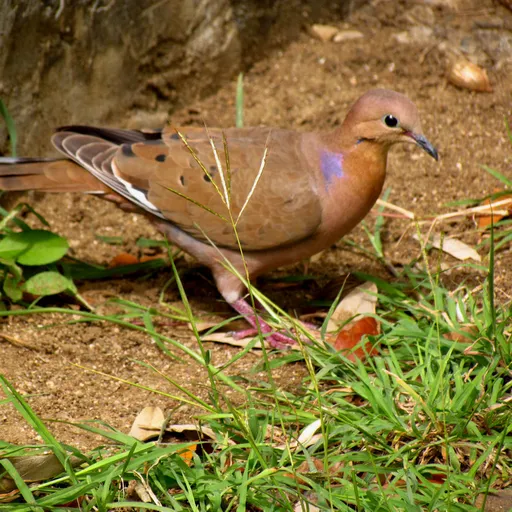
Zenaida Dove
Zenaida aurita
Least Concern
Overview
The Zenaida dove is a member of the bird family Columbidae and the type species of the genus Zenaida. It is closely related to the mourning dove and the eared dove.
Identification
- Approximately 28–30 cm in length, smaller and darker than the mourning dove with a shorter, more rounded tail.
- Shows white on the trailing edge of its wings when in flight.
- Features black auricular patches located close to the eyes.
- Emits a mournful cooOOoo-coo-coo-coo call that is similar to a mourning dove but faster in pace.
Habitat
Its range extends throughout the Caribbean islands and along the northern coast of the Yucatan Peninsula. The bird prefers open and semi-open habitats such as lowlands, coastal plains, and bushy scrublands, though it can be found at higher elevations in Jamaica and has adapted to urbanised areas like city parks and agricultural lands. The Z. a. salvadorii subspecies is particularly adapted to coastal and aquatic ecosystems, including mangrove forests and atolls.
Diet
These birds forage on the ground, primarily consuming grains and seeds, and occasionally eating insects. They frequently feed close to water and swallow fine gravel to aid digestion. They also ingest salt from mineral-rich soils or livestock salt licks, which is thought to aid in egg formation and the production of pigeon milk.
Did you know?
The species epithet, aurita, means "eared" or "having ears" in Latin, referring to the black auricular patches located close to their eyes where their ears would be. It is the national bird of the British Overseas Territory of Anguilla, where it is locally known as the turtle dove.
Sources
- Wikipedia · CC BY-SA 4.0
- Wikidata · CC0 1.0