
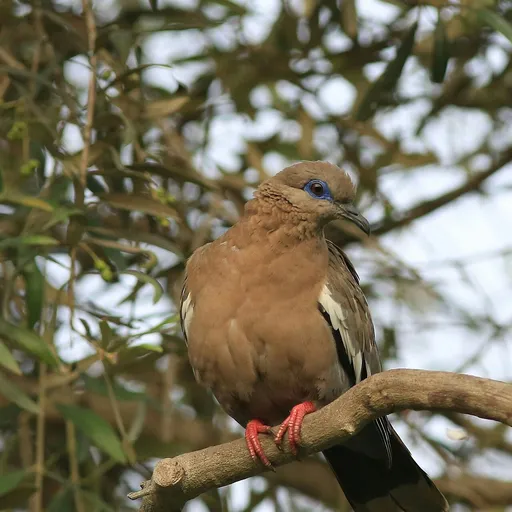
West Peruvian Dove
Zenaida meloda
Least Concern
Overview
The West Peruvian dove, also known as the Pacific dove or Zenaida meloda, is a species of dove found on the South American Pacific coast. It is a medium-sized bird that was previously considered the same species as the white-winged dove but is now recognized as distinct based on genetic and morphological differences.
Identification
- Medium-sized dove measuring 25–33 cm, with brownish-gray upperparts, a buff face and neck, and warm gray underparts with pinkish tinging.
- Features a prominent white wing band visible as a crescent, gray-tipped tailfeathers with a broad white corner, and red legs and feet.
- Possesses a featherless ring of bright indigo to violet-blue skin around each eye, which is absent in juveniles.
- Produces a low-pitched, rhythmic cooing song and a distinctive coo-coo-LEE call that gives rise to its local name, cuculí.
Habitat
Found along the Pacific coast of South America from southwestern Ecuador to central Chile and southern Argentina, typically at elevations up to 3,000 m, though recorded as high as 4,200 m in Chile. It inhabits arid open and semi-open environments, including desert lowlands, palm oases, coastal valleys, scrubland, and dry open savanna. The species readily colonizes human-altered areas such as croplands, irrigated valleys, city parks, gardens, and urban zones.
Diet
Feeds on the ground and in trees, primarily consuming grains and seeds. It has been observed foraging alongside the eared dove.
Did you know?
The species is expanding its range southwards, having reached as far as the Biobío Region in Chile and Santa Cruz Province in Argentina, with records even extending to the Falkland Islands.
Sources
- Wikipedia · CC BY-SA 4.0
- Wikidata · CC0 1.0