
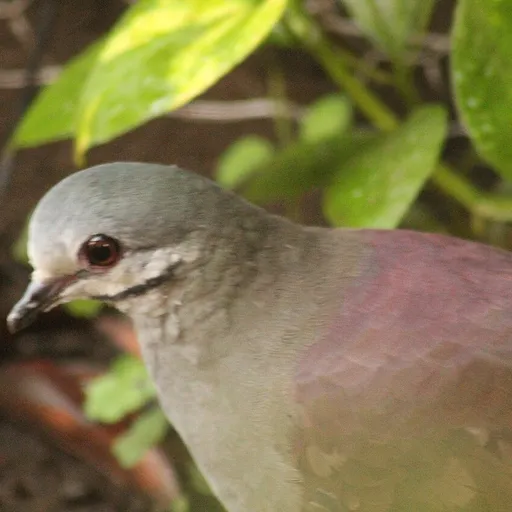
Tuxtla Quail-Dove
Zentrygon carrikeri
Endangered
Overview
The Tuxtla quail-dove, also known as the Veracruz quail-dove, is a species of bird in the family Columbidae. It is endemic to southeastern Mexico and has been assessed as Endangered by the IUCN due to its small and fragmented range.
Identification
- Length ranges from 20 to 31.5 cm.
- Adults have a light bluish gray head, neck, throat, and breast, with light brown flanks and olive brown back and wings.
- A wide black malar stripe is present on the face.
- The song consists of a three-syllable note 'whu-hu-whUuuw', with emphasis on the last syllable.
Habitat
The Tuxtla quail-dove is found exclusively on two volcanoes in the Sierra de los Tuxtlas of Veracruz, Mexico: Volcán de San Martín and Sierra de Santa Marta. It inhabits humid evergreen forest and cloudforest at elevations between 350 and 2,100 m.
Diet
The Tuxtla quail-dove forages singly or in pairs. While specific diet details are not published, it probably feeds on fruit, seeds, and invertebrates found in leaf litter.
Did you know?
The only documented nest was a loosely constructed platform supported by bamboo shoots that contained a single egg.
Sources
- Wikipedia · CC BY-SA 4.0
- Wikidata · CC0 1.0