
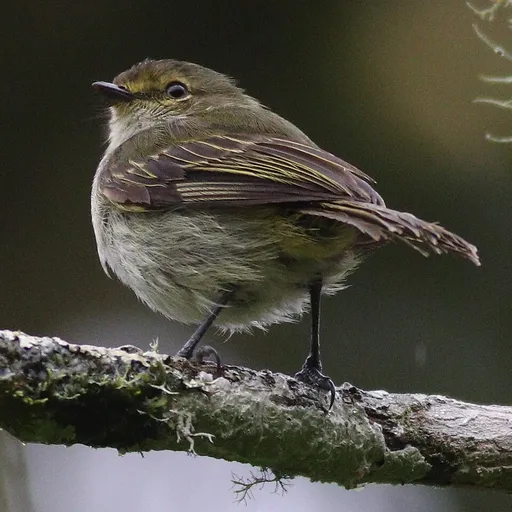
Choco Tyrannulet
Zimmerius albigularis
Least Concern
Listen
XC248566 · Niels Krabbe · Pichincha: ridge between Río Mindo and Río Nambillo, 3 km SE Mindo, Ecuador · CC BY-SA 4.0
Overview
The Choco tyrannulet (Zimmerius albigularis) is a small bird in the family Tyrannidae, the tyrant flycatchers. It is found in the Chocó bioregion of Colombia and Ecuador and is assessed as being of Least Concern on the IUCN Red List.
Identification
- Measures 10.5 to 11.5 cm in length and weighs 6.6 to 8.6 g.
- Features a mottled yellow forehead, dusky lores, yellow supercilium, dark eye stripe, and golden-brown ear coverts.
- Dark olive crown, back, and rump, with dusky wings edged in yellow on the coverts and flight feathers.
- Throat is whitish, breast pale grey with a pale yellow tinge on the sides, and belly whitish.
- Has a small, rounded, black bill and grey or black legs.
- Dawn song is described as a querulous, ascending 'treeu, tree-ree-ree-ree?', with a call of a simple 'cheli' repeated over and over.
Habitat
Inhabits the Chocó bioregion, ranging from southwestern Colombia's Cauca Department south on the western side of the Andes through Ecuador to Santa Elena and Guayas provinces. It lives in the interior and edges of humid lower montane forest, mature secondary woodland, coffee plantations, and gardens. Elevation ranges from near sea level to 1,500 m in Colombia and up to 1,600 m in Ecuador.
Diet
Feeds on insects and small fruits, particularly those of mistletoes (Loranthaceae). Forages singly or in pairs, and sometimes joins mixed-species feeding flocks. Forages mostly in the forest canopy, perching horizontally with its tail cocked, and actively moves about and gleans food while perched or with short flights.
Did you know?
Nothing is known about the Choco tyrannulet's breeding biology. Despite being locally common in Colombia and widespread and often common in Ecuador, its population size is not known and is believed to be decreasing.
Sources
- Wikipedia · CC BY-SA 4.0
- Wikidata · CC0 1.0