
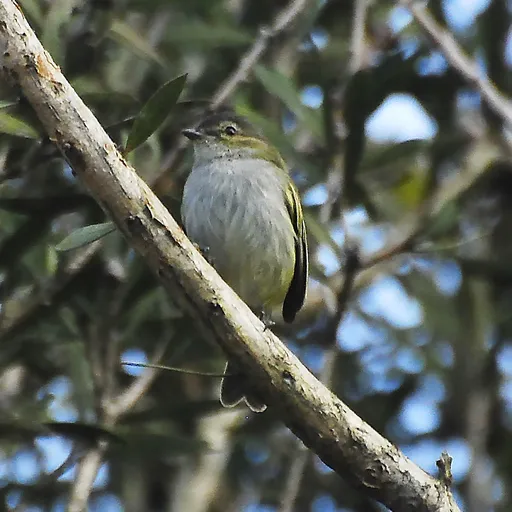
Mistletoe Tyrannulet
Zimmerius parvus
Least Concern
Listen
XC494362 · Oliver Komar · Pipeline Trail entrance, Los Naranjos, Boquete, Provincia de Chiriquí, Panama · CC BY-SA 4.0
Overview
The mistletoe tyrannulet (Zimmerius parvus) is a very small passerine bird belonging to the family Tyrannidae, commonly known as the tyrant flycatchers. It is a year-round resident found in the Caribbean regions of Central America and parts of northwestern Colombia, classified by the IUCN as being of Least Concern.
Identification
- Measures approximately 9.5 to 10 cm in length and weighs between 8.5 and 10 g.
- Adults feature a grayish crown, olive green upperparts, and mostly off-white underparts with faint darker breast streaks.
- Short, wide whitish supercilium and short, dusky gray or black bill.
- Dawn song consists of a slow, dropping syllable followed by short, rising notes ('yer-de-dee') and often a trill, with calls described as 'pyeer' or 'peeyup'.
Habitat
Distributed from Guatemala and Belize through the Caribbean sides of Central America to the Antioquia and Chocó departments of northwestern Colombia. It inhabits tropical to lower temperate zones, including the interior and edges of evergreen forest, secondary forest, pastures, fields with scattered trees, and gardens. The species ranges in elevation from sea level up to 3,000 m, favouring areas that contain mistletoes.
Diet
Feeds on mistletoe berries, other fruits, insects, and spiders. It forages actively as an individual or in pairs, and in Panama joins mixed-species feeding flocks. It captures arthropods by gleaning from perches and obtains fruit by gleaning or briefly hovering at clusters.
Did you know?
The female constructs oval nests with a side entrance from mosses and plant fibers bound with spider web, lining them with seed down and typically placing them 2 to 15 m above the ground in hanging moss or lichen.
Sources
- Wikipedia · CC BY-SA 4.0
- Wikidata · CC0 1.0