
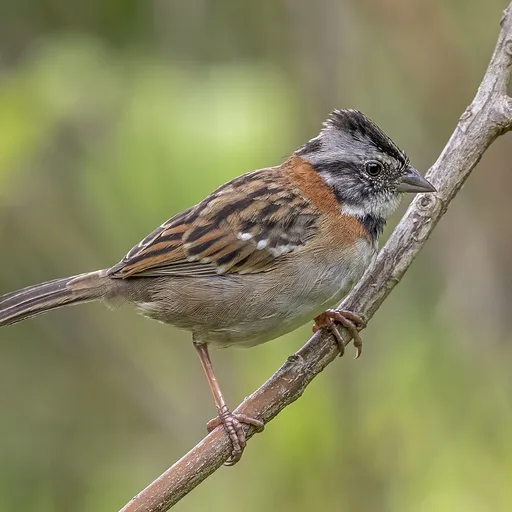
Rufous-collared Sparrow
Zonotrichia capensis
Least Concern
Listen
XC958856 · Beth Cottam · Cerro de La Muerte--km 70, Mirador de Quetzales, Costa Rica · CC0 1.0
Overview
The rufous-collared sparrow (Zonotrichia capensis), also known as the Andean sparrow, is an American sparrow found across a vast range from the extreme south-east of Mexico to Tierra del Fuego. It is a generally abundant bird that copes well with urban and suburban environments and is often seen near humans.
Identification
- Adults measure 13.5–15 cm in length and feature a grey head with broad black crown stripes and thinner stripes through the eye.
- The nape and breast sides are rufous, contrasting with black-streaked buff-brown upperparts and a black breast patch on off-white underparts.
- The bill is stubby and grey, with two white wing bars visible on the wings.
- The male's song consists of slurred whistles, such as tee-teeooo, often finished with a terminal trill, while calls include a sharp tsip.
Habitat
This species inhabits virtually any open or semi-open environment, including cultivations, gardens, parks, grasslands, and scrubby second growth, while avoiding the dense forests of the Amazon Basin. In northern and western parts of its range, it is typically found at altitudes of 600–4,000 m, but in southern and eastern regions, it is commonly found near sea level.
Diet
The rufous-collared sparrow feeds on the ground on seeds, fallen grain, insects, and spiders, sometimes joining mixed-species feeding flocks. It has been observed picking termites from spider webs and is usually seen in pairs holding small territories or in small flocks.
Did you know?
The bird's vocal dialects are tightly linked to specific habitat types, with rapid trills in open grasslands and slower whistles in woodlands, a pattern that can persist for centuries even after the native vegetation has been removed by agriculture.
Sources
- Wikipedia · CC BY-SA 4.0
- Wikidata · CC0 1.0