
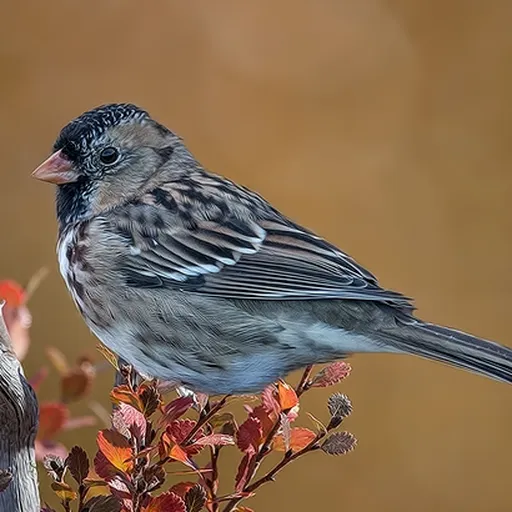
Harris's Sparrow
Zonotrichia querula
Near Threatened
Overview
Harris's sparrow is a large bird in the family Passerellidae that is Canada's only endemic breeding species. It breeds in the northern boreal forests of central Canada and migrates to the Great Plains of the United States for the winter. Classified as Near Threatened by the IUCN, the species faces declining populations, though the exact causes remain a mystery.
Identification
- Size: Total length ranges from 17 to 20 cm with a wingspan of 27 cm; it is the largest sparrow in the family Passerellidae.
- Breeding Plumage: Features a black crown, face, throat, and upper breast contrasting with grey head sides; the back is brown with heavy black streaking, and two white wing bars are present.
- Non-breeding/Immature Plumage: Adults appear more buffy with reduced black markings, while immatures have less black, a white chin and throat, and a smudgy black breast-band.
- Song: Delivered from a high perch, it consists of clear, high wavering whistles followed by another series in a different pitch, sometimes accompanied by a strong, metallic chink.
Habitat
Breeding habitat consists of stunted coniferous forests and adjacent scrubs, particularly where spruce stands abut mossy bogs near the forest-tundra ecotone. Wintering grounds include open woodlands, woodland edges, clearings, hedgerows, and dense riparian thickets in the Great Plains of the United States, where they avoid dry shortgrass prairies and dense woods.
Diet
Generally feeds on the ground by scratching in leaves and soil for seeds, primarily of Carex sedges, grasses, and Scirpus bulrush. During the breeding season, the diet also includes fruits such as black crowberry and mountain bearberry, as well as larval invertebrates like beetles, flies, and caterpillars from June to September.
Did you know?
In winter flocks, dominance hierarchies are so strongly linked to appearance that first-year birds dyed black to mimic the large black 'bibs' of mature males will rise in status to surpass females and other young males.
Sources
- Wikipedia · CC BY-SA 4.0
- Wikidata · CC0 1.0