
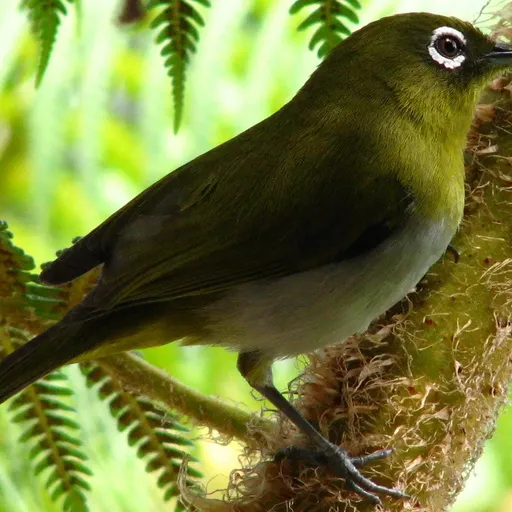
Sri Lanka White-eye
Zosterops ceylonensis
Least Concern
Overview
The Sri Lanka white-eye, Zosterops ceylonensis, is a small passerine bird endemic to Sri Lanka and classified as Least Concern on the IUCN Red List. It is a resident breeder found primarily in the highlands, occupying forests, gardens, and plantations.
Identification
- Approximately 11 cm long, slightly larger than the Indian White-eye, with a dark olive-green upper body and darker crown.
- Features a conspicuous ring of tiny white feathers around the yellow to reddish-brown iris, accompanied by dark lores and a dark streak below the eye.
- The bill is dark with a slaty base to the lower mandible, and the legs are dark.
- Distinguished from the Indian White-eye by its larger size, duller green back, and more extensive greenish-yellow plumage on the chin, throat, and upper breast.
Habitat
This species resides in Sri Lanka, where it is a resident breeder in forests, gardens, and plantations, mainly located in the highlands. It occupies the ecological niche above 4000 ft, replacing the widespread Indian White-eye at these elevations.
Diet
Though mainly insectivorous, the bird also consumes nectar and fruits of various kinds.
Did you know?
Taxonomic studies suggest that this species is the root species which gave rise to all white-eyes on Earth, raising further questions regarding white-eye origins. Its scientific name, Zosterops, is Greek for 'girdle-eye', referring to the bird's conspicuous white eye ring.
Sources
- Wikipedia · CC BY-SA 4.0
- Wikidata · CC0 1.0