
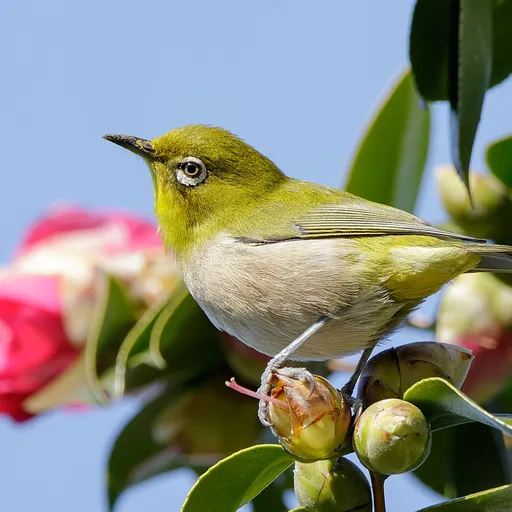
Warbling White-eye
Zosterops japonicus
Least Concern
Listen
XC176944 · Peter Wilton · North Taliabu, Kepulauan Sula, North Maluku, Indonesia · CC BY-SA 4.0
Overview
The warbling white-eye is a small passerine bird native to much of East Asia, including the Russian Far East, Japan, Indonesia, Korea, and the Philippines. It has been intentionally introduced to other parts of the world as a pet and for pest control. As one of the native species of the Japanese islands, it has been frequently depicted in Japanese art and historically kept as a cage bird.
Identification
- Olive green on the back and pale green on the underside, with a yellow throat and a distinctive white eyering.
- Adults range from 4 to 4.5 in (10 to 11 cm) in length and weigh between 9.75 and 12.75 grams.
- Feet, legs, and bill range from black to brown, with a long, slender bill and rounded wings indicating acrobatic flight.
- Wings are dark brown but outlined in green.
Habitat
Native to much of East Asia, the species is widespread and common in Japan, where it is considered one of the more dominant bird species. It has expanded to every island of Hawaii, thriving in climates ranging from tropical rain forests to deciduous forests. Migratory populations spend winters in Burma, Thailand, Hainan Island, and Vietnam.
Diet
This omnivorous bird feeds on fruit from several species of flowering plants, various types of insects, and nectar at all levels of foliage. It forages by searching the leaves of flowers and scouring tree bark for larvae. Its diet contributes to the regulation of local insect populations and the dispersal of seeds.
Did you know?
The common Japanese name for the bird, mejiro, translates literally to "white eye," a reference to the distinctive white eyering that gives the group its English name. When building nests, the birds often steal material from the nests of other birds.
Sources
- Wikipedia · CC BY-SA 4.0
- Wikidata · CC0 1.0