
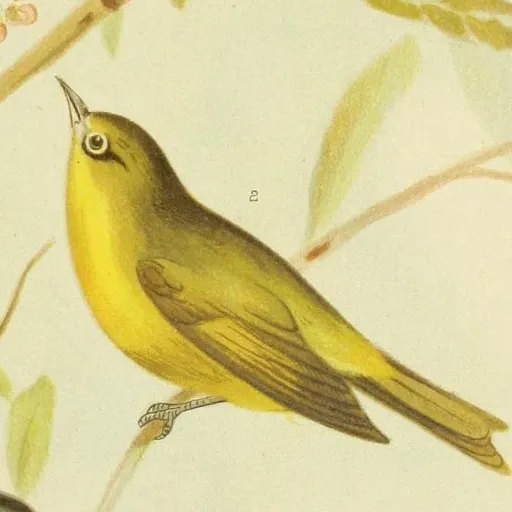
Canary White-eye
Zosterops luteus
Least Concern
Overview
The canary white-eye, also known as the yellow white-eye, is a small bird species endemic to northern Australia. Its common name reflects the distinctive circle of white feathers around its eye.
Identification
- Small white-eye, 100–110 mm long, with a wingspan of 52–59 mm and weighing 6.5–11.0 g.
- Bright olive back and yellow underparts and lores.
- Characteristic ring of silver-white feathers around the eyes and a dark loral stripe.
- Short, sharp beak with a brush-tipped tongue.
Habitat
Found in subtropical or tropical mangrove forests, mangal, and adjacent riverine vegetation in northern Australia. The species has two subspecies, one in the western coastal region and one in the eastern coastal region, with an isolated population in eastern Queensland.
Diet
The canary white-eye is a nectar feeder that also eats insects, including larvae, found in the outer foliage of small trees or shrubs. It occasionally forages on muddy mangrove flats.
Did you know?
The most commonly used name for the species in Australia is yellow white-eye, not canary white-eye. Its scientific name, Zosterops luteus, derives from the Latin luteus, meaning golden or saffron yellow.
Sources
- Wikipedia · CC BY-SA 4.0
- Wikidata · CC0 1.0